
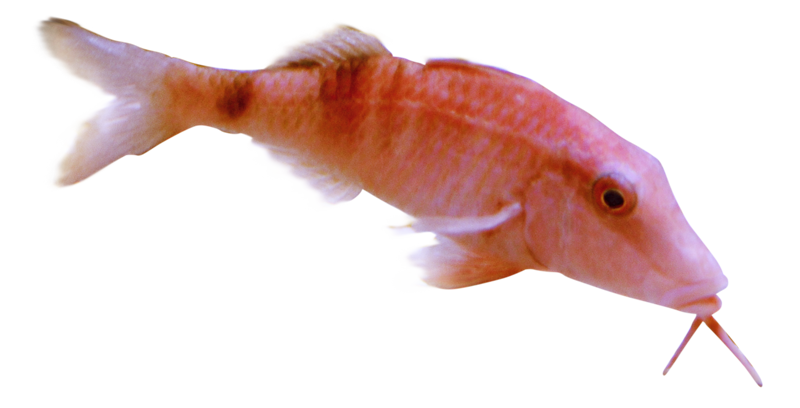
Parupeneus multifasciatus (Quoy & Gaimard, 1825)
ヒゲが自慢のオジサン
The Proud Barbels of the Manybar Goatfish
体長は約25cm。オジサンはインド洋から西太平洋にかけて広く分布し、日本では千葉県以南の太平洋岸の温暖な海域に生息するヒメジ科の魚です。赤みを帯びた体色に暗色の帯状斑が数本入ることが特徴で、この模様が英名「Manybar goatfish」の由来となっています。沿岸の砂底や岩礁域に生息し、日中は単独または小さな群れで海底付近を遊泳します。
和名の「オジサン」は、その外見に由来します。口元に生えたヒゲのような器官が人の「おじさん」を思わせることから名付けられました。このヒゲは正確には「触鬚(しょくしゅ)」と呼ばれ、餌を探すための重要な感覚器官です。内部には神経束が通り、その周囲に味蕾が密集しており、水中の化学的な刺激を感知します。オジサンはこの触鬚を使って砂中や岩の表面を探り、小型の甲殻類やゴカイ類などの餌を見つけ出します。また、触鬚は使わないときには顎の下に折りたたんで収納することができます。
さらに本種は、海底生活に適応したいくつかの特徴を備えています。採餌の際には触鬚で砂を掘り返しながら餌を探すため、結果として海底の堆積物がかき混ぜられ、底質環境に影響を与えている可能性があります。また、日中は鮮やかな体色を示しますが、夜間には体色が淡くなり模様も不明瞭になることが知られており、周囲に溶け込む保護的な役割を果たしていると考えられます。これらの行動や体色変化は、本種が海底で生活するうえでの適応をよく示しています。
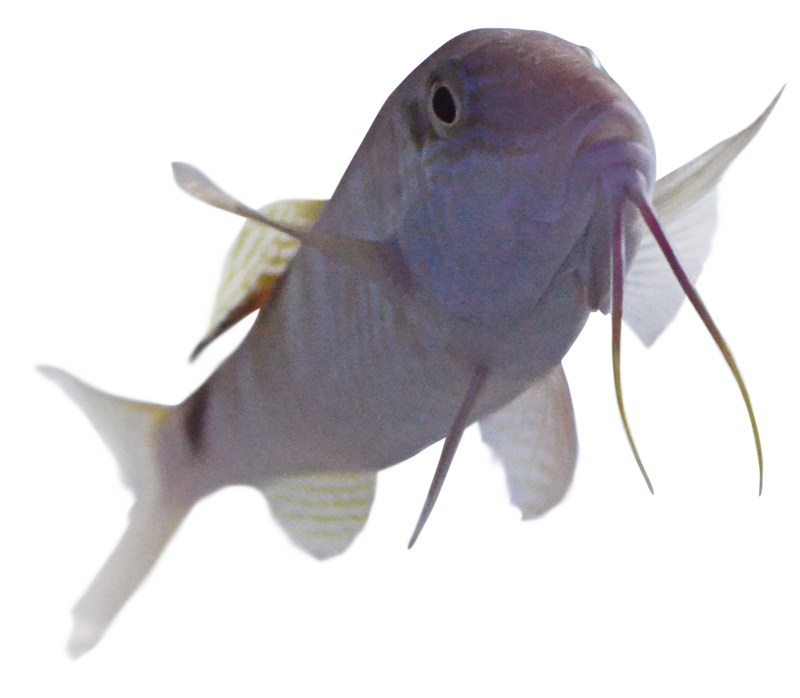
The Manybar goatfish reaches about 25 cm in length. It is widely distributed from the Indian Ocean to the western Pacific, and in Japan it inhabits warm coastal waters along the Pacific coast south of Chiba Prefecture. Its reddish body is marked with several dark longitudinal bands, a feature that gives rise to its English name “Manybar goatfish.” It lives over sandy bottoms and rocky areas in coastal zones, where it is typically seen swimming near the seabed alone or in small groups during the day.
The Japanese name “Ojisan” (meaning “middle-aged man”) comes from its appearance. The whisker-like organs around its mouth resemble a man’s beard. These structures are actually called barbels and serve as important sensory organs for detecting food. Inside the barbels run bundles of nerves, surrounded by numerous taste buds that can detect chemical stimuli in the water. Using these barbels, the fish probes sand and rock surfaces to locate prey such as small crustaceans and polychaete worms. When not in use, the barbels can be folded and tucked neatly beneath the lower jaw.
This species also shows several adaptations to a benthic lifestyle. While foraging, it stirs up the substrate with its barbels, which can disturb and mix the sediments and potentially influence the seafloor environment. In addition, although it displays vivid coloration during the day, its body becomes paler and its markings less distinct at night, likely serving as camouflage. These behaviors and color changes clearly reflect its adaptation to life on the seafloor.
参考文献
ぼうずコンニャクの市場魚貝類図鑑 | オジサン 2024年10月13日閲覧
WEB魚図鑑 | オジサン 2024年10月13日閲覧
海遊館 | ブログ「海遊館日記」 | 顔博の「オジサン」 | (2017年5月24日) 2024年10月13日閲覧
東京魚チング | ヒメジのオジサン 2024年10月13日閲覧
美ら海だより | 【はいさいオジサン】 | (2023年8月22日) 2024年10月13日閲覧