
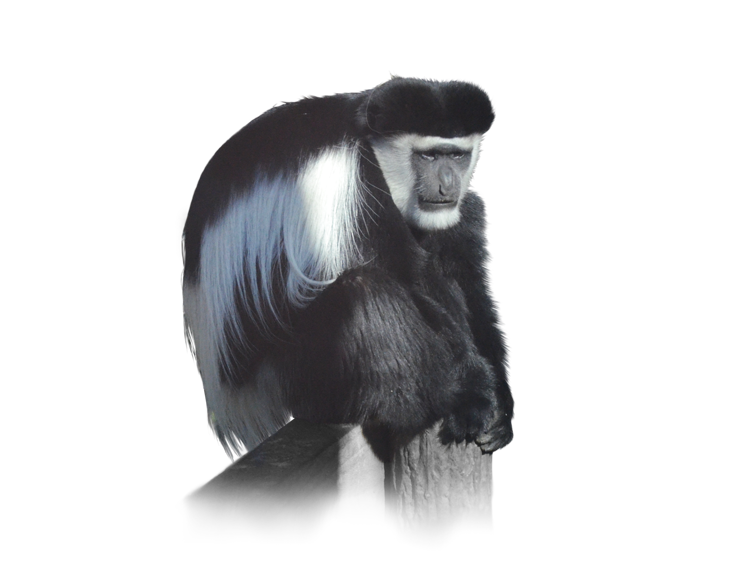
Colobus guereza (Ruppell, 1835)
跳躍する白と黒のシルエット
A Leaping Silhouette in Black and White
アビシニアコロブスは、頭胴長約60cm、尾長約65cm、体重7〜13kgのオナガザル科のサルで、アフリカ東部から中央部にかけての熱帯雨林に分布します。全体は黒い体色をしていますが、顔の周囲は白く、肩から背中にかけて垂れ下がるマント状の長い白毛と、尾の先にある房状の白毛が大きな特徴です。胴よりも長い尾は枝を掴むためには使われませんが、跳躍時に舵のように働き、空中での姿勢制御やバランス保持に役立っています。
一日の大半を樹上で過ごし、主に樹冠部で生活します。樹上には葉に含まれる水分が豊富にあり、硬い葉も三つに分かれた胃で効率よく消化できるため、葉を中心とした食生活だけで生きることが可能です。このため地上に降りることは少なく、強い樹上適応を示します。臀部には坐骨胼胝が発達しており、長時間枝に座ることができます。また親指はほとんど退化しており、小さな突起と爪の名残があるのみで、四本の指をフックのように使って枝から枝へと巧みに移動します。
コロブス(Colobus)という名は、ギリシャ語で「切り刻まれた」を意味し、退化した親指に由来します。アビシニアはタイプ産地であるエチオピアの古称です。通常8〜15頭ほどの群れで生活し、1頭の優位な雄と複数の雌、その子どもたちから構成されます。群れごとに一定の行動圏を持ち、明け方には雄が大きな咆哮を発して他群に存在を知らせます。さらに鳴き声とともに樹冠から下方の枝へ跳躍や落下を繰り返す「ジャンプ・ロアリング・ディスプレイ」を行い、視覚的にも自らを誇示します。跳躍時に大きくはためく白い毛のマントは、きわめて印象的な光景です。
同属の群れとは距離を保つ一方で、ブルーモンキーCercopithecus mitisやヴェルヴェットモンキーChlorocebus pygerythrusなど他のオナガザル類と同じ森林に生息し、混群や空間的共生を示すことがあります。食性や森林内で利用する高さが異なるため競合は少なく、捕食者への警戒において相互に利益を得ていると考えられています。
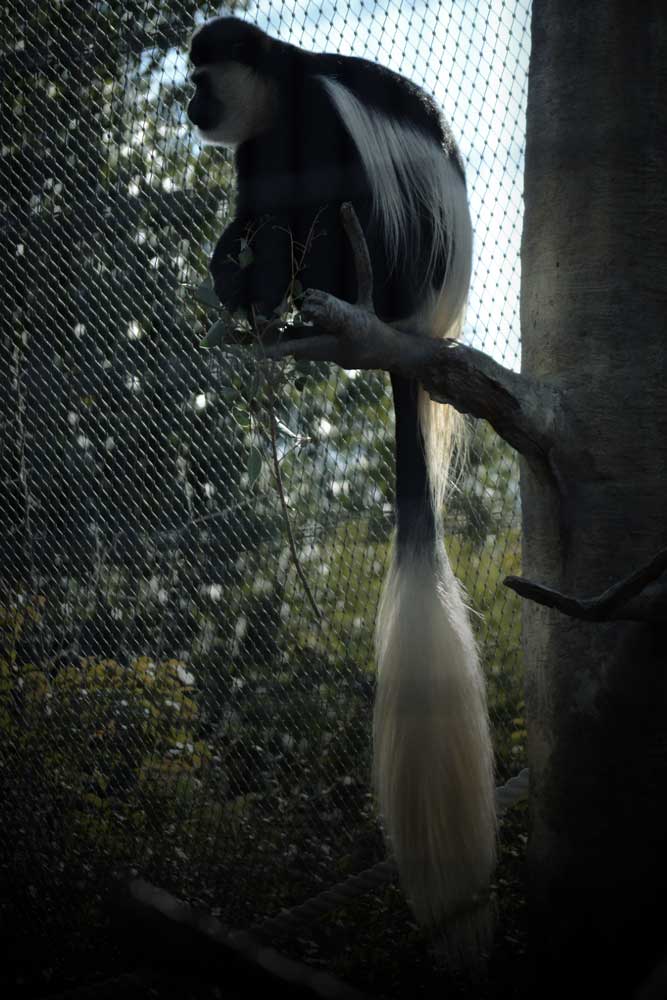
Distinguished by its long tail and extended tuft of hair.
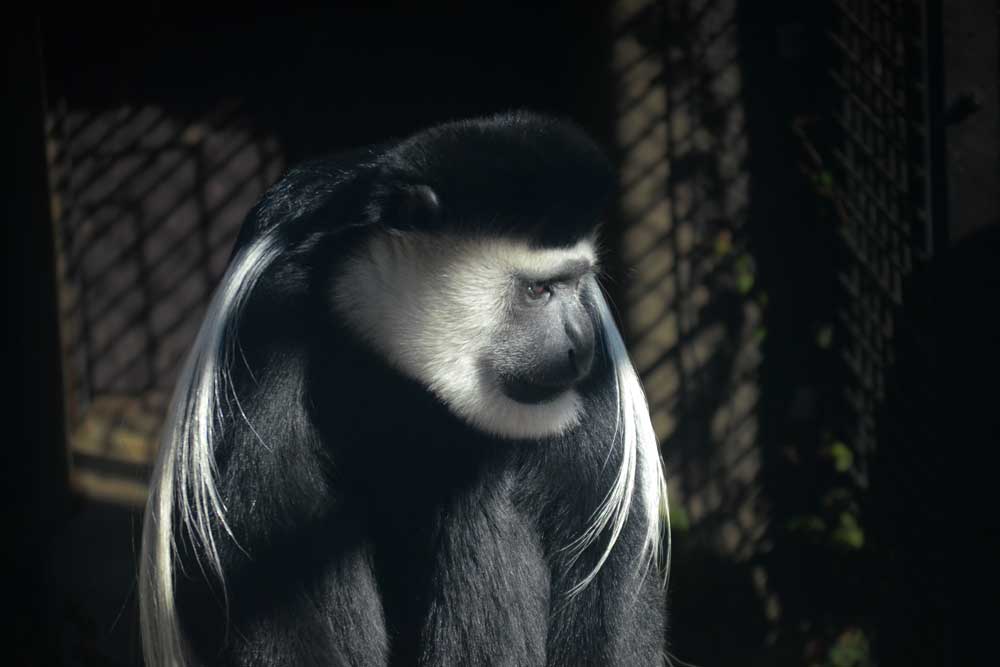
The hair extending from the shoulders resembles a flowing fringe.
The mantled guereza is a member of the family Cercopithecidae, with a head–body length of approximately 60 cm, a tail length of about 65 cm, and a body weight ranging from 7 to 13 kg. It is distributed throughout the tropical rainforests of eastern to central Africa. The body is predominantly black, but the face is framed with white hair, and the species is characterized by long, white mantle-like hair draping from the shoulders down the back, as well as a conspicuous white tuft at the tip of the tail. Although the tail is longer than the body, it is not used for grasping branches; instead, it functions like a rudder during leaps, aiding in aerial posture control and balance.
The mantled guereza spends most of the day in trees, primarily inhabiting the forest canopy. Leaves in the canopy provide sufficient water, and even tough foliage can be efficiently digested by its specialized, three-chambered stomach, allowing it to survive on a predominantly folivorous diet. As a result, it rarely descends to the ground and shows strong adaptations to an arboreal lifestyle. Well-developed ischial callosities enable individuals to sit on branches for extended periods. The thumb is highly reduced, remaining only as a small protrusion with a vestigial nail, while the four elongated fingers function like hooks, allowing agile movement from branch to branch.
The name Colobus derives from the Greek word meaning “mutilated” or “cut short,” referring to the reduced thumb. “Guereza” is believed to originate from a local Ethiopian name for the animal. Mantled guerezas typically live in groups of about 8 to 15 individuals, consisting of a single dominant male, multiple females, and their offspring. Each group occupies a defined home range, and at dawn the male emits loud roars to signal the group’s presence to neighboring troops. In addition, males perform an active “jump–roar display,” repeatedly leaping and dropping from the canopy to lower branches while vocalizing, visually advertising their presence. During these displays, the flowing white mantle hair billows dramatically, creating a striking spectacle.
While maintaining distance from other groups of the same species, the mantled guereza often shares forests with other cercopithecine monkeys, such as the blue monkey (Cercopithecus mitis) and the vervet monkey (Chlorocebus pygerythrus), sometimes forming mixed-species associations or showing spatial coexistence. Because these species differ in diet and in the vertical strata of the forest they use, direct competition is limited, and such associations are thought to provide mutual benefits, particularly in vigilance against predators.
参考文献
“Guereza Colobus Monkey” Animal Fact Guide. 2026年2月11日閲覧
“Colobus Monkey” African Wildlife Foundation. 2026年2月11日閲覧
“Black-and-White Colobus” Los Angeles Zoo & Botanical Gardens. 2026年2月11日閲覧
“Black and White Colobus Monkey” Minnesota Zoo. 2026年2月11日閲覧
“Guereza Colobus” New England Primate Conservancy. 2026年2月11日閲覧
Gron KJ. 2009 May 12. Primate Factsheets: Guereza (Colobus guereza) Taxonomy, Morphology, & Ecology. 2026年2月11日閲覧