
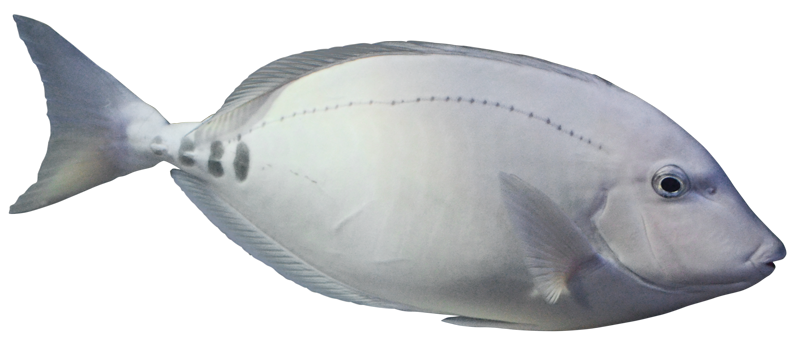
Prionurus scalprum (Valenciennes, 1835)
磯臭さを払拭して食卓へ
From a Strong Marine Odor to the Dinner Table
東アジア沿岸の暖海域に生息するニザダイ科の魚で、浅い岩礁域などで見られます。成魚は全長40cmほどになり、最大で50cmに達します。尾柄部には左右それぞれ4~5個の硬い骨質板が並び、その後方には鋭い突起があります。周囲には黒い斑点があり、そのうち3個が特に大きく目立つことから、地方名の「サンノジ」は、これらを漢字の「三」に見立てたことに由来します。英名のJapanese sawtailも、ノコギリのような尾柄部の突起にちなむ名前です。
尾柄部の突起は、ニザダイ類を特徴づける武器の一つです。外敵から身を守る際に役立つほか、人が不用意に触れると鋭い突起で傷つくことがあります。さらに、背鰭や臀鰭などの棘には毒腺があることも知られており、見た目だけでなく取り扱いにも注意が必要な魚です。
主に藻類を食べる植食性の魚で、岩の表面などに付着した藻類を小さな口で削り取るように食べます。こうした食性に加え、消化管が長いことなどが、独特の磯臭さにつながるとされ、一般の市場では流通量が多くありません。一方で、適切に処理すれば食用として利用でき、近年では臭みを抑えるためにキャベツを餌として養殖したニザダイが商品化されるなど、これまで「未利用魚」とされがちだった魚を食資源として活用する試みも進められています。
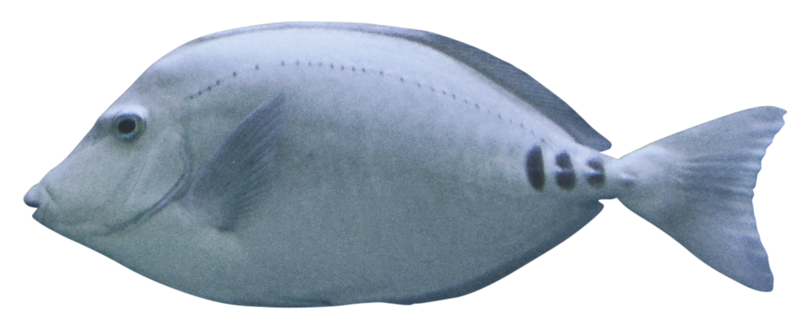
The Japanese sawtail is a member of the surgeonfish family that inhabits warm coastal waters of East Asia. It is commonly found around shallow rocky reefs. Adults grow to around 40 cm in total length and can reach more than 50 cm. Four to five hard bony plates line each side of the caudal peduncle, ending in sharp projections. Dark spots surround these structures, three of which are particularly conspicuous. The Japanese regional name “Sannoji” comes from the resemblance of these three spots to the Japanese character for “three,” 三. The English name Japanese sawtail also refers to the saw-like projections on the caudal peduncle.
These projections are among the fish’s most distinctive defensive structures. They can be used against predators and may cause injury if the fish is handled carelessly. In addition, the spines of the dorsal and anal fins are known to be associated with venom glands, making this fish one that should be handled with care despite its otherwise unassuming appearance.
The Japanese sawtail is primarily herbivorous, feeding on algae by scraping them from rocks and other surfaces with its small mouth. Its diet, together with its long digestive tract, is thought to contribute to its distinctive marine odor. As a result, it has traditionally had relatively little commercial value and is not widely distributed in markets. Nevertheless, it can be eaten when properly prepared. In recent years, efforts have been made to turn this underutilized fish into a food resource, including the commercial production of farmed Japanese sawtail fed on cabbage to reduce its strong odor.
参考文献
ぼうずコンニャクの市場魚貝類図鑑 | ニザダイ 2024年7月13日閲覧
東京島しょ農林水産総合センター | 東京おさかな図鑑 | ニザダイ 2025年5月25日閲覧
東京都島しょ農林水産総合センター | 東京おさかな図鑑 | ニザダイ 2026年9月12日閲覧