
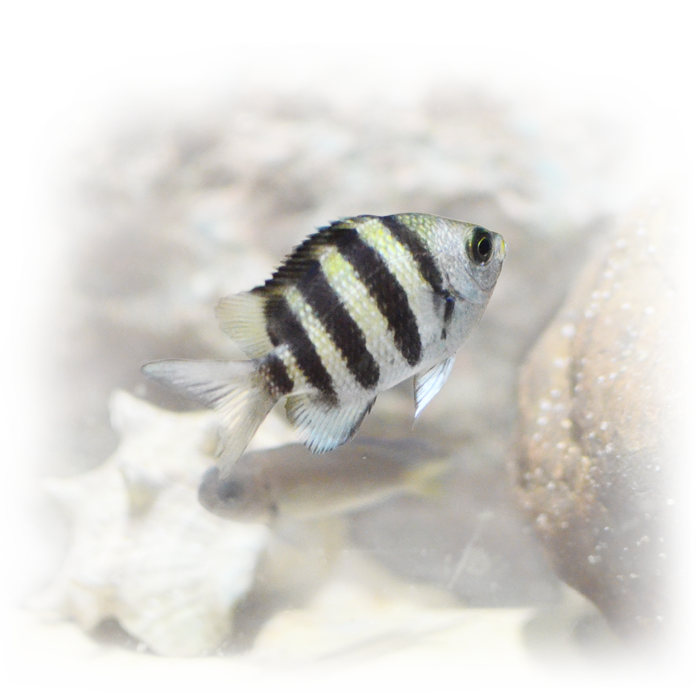
Abudefduf vaigiensis (Quoy & Gaimard, 1825)
インド太平洋の軍曹
The Sergeant Major of the Indo-Pacific
体長約20cm。紅海からインド太平洋にかけて広く分布する、スズメダイ科の中では比較的大型の種で、サンゴ礁や岩礁域の浅海に普通に見られます。奄美大島では食用とされることもあります。和名「オヤビッチャ」は印象的な響きをもちますが、その語源には諸説あり、有力なのは沖縄の方言名「アヤビチャー」に由来するという説です。「綾が走る」、すなわち体表に模様が入ることを意味し、本種の特徴をよく表しています。奄美大島で「アヤビキ」と呼ばれる点も、この説の信憑性を補強しています。
体は強く側扁し体高が高く、白色の地に5本の明瞭な黒色横帯が入ります。背部は鮮やかな黄色を帯び、遠目にもよく目立ちます。近縁のロクセンスズメダイとよく似ていますが、後者は尾びれにも縞模様が現れるため識別可能です。また、大西洋に分布する近縁種 Abudefduf saxatilis とも酷似しています。本種を含むこれらの魚は、黒帯が軍曹の階級章を連想させることから英名「Sergeant major(軍曹)」と呼ばれ、オヤビッチャの英名もこれに由来しています。
The Indo-Pacific sergeant reaches about 20 cm in length. It is widely distributed from the Red Sea to the Indo-Pacific and is relatively large among damselfishes, commonly inhabiting shallow coral and rocky reefs. In Amami Ōshima, it is sometimes used as food. The Japanese name “Oyabiccha” has a distinctive sound, and while its origin is debated, the most widely accepted theory is that it derives from the Okinawan dialect name “Ayabichā.” This term means “pattern running across,” referring to the presence of markings on the body, aptly describing the species’ appearance. The fact that it is called “Ayabiki” in Amami Ōshima further supports this interpretation.
The body is strongly laterally compressed and deep, with five distinct black vertical bands on a white background. The dorsal area is bright yellow, making it highly conspicuous even from a distance. It closely resembles the related species Abudefduf vaigiensis, but can be distinguished by the absence of stripes on the caudal fin, which are present in the latter. It is also very similar to the Atlantic species Abudefduf saxatilis and is often confused with it. These fishes are commonly called “Sergeant major” in English, as their bold black bands resemble military rank insignia, and the English name of the Indo-Pacific sergeant follows this convention.
参考文献
琉球新報 | 沖縄用語辞典 | オヤビッチャ | (2003年3月1日) 2025年4月20日閲覧
奄美小町・名瀬漁協便り | アヤビキです。| (2012年7月20日) 2025年4月20日閲覧
京都大学白浜水族館「ここで見分けろ! ~オヤビッチャ編~」(2023年3月) 2025年4月20日閲覧
“Sergeant Major” Discover Fishes, Florida Museum. 2025年4月20日閲覧