
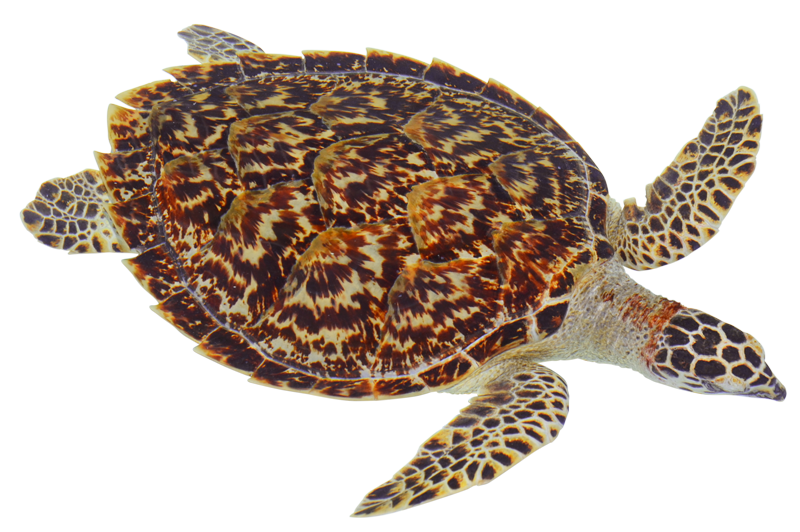
Eretmochelys imbricata (Linnaeus, 1766)
甲羅の特性が生んだ装飾文化
The Ornamental Culture Born from a Unique Shell
甲長70〜90cm、体重約80〜120kgに達する大型のウミガメで、インド洋、大西洋、太平洋の熱帯から亜熱帯の海域に広く分布します。主な生息場所はサンゴ礁や岩礁域で、鋭く湾曲したクチバシを使って岩の隙間に入り込んだ海綿動物や甲殻類などを捕食します。特に海綿を主食とすることで、サンゴ礁生態系の中で独自の役割を担っています。
背甲は黄色から褐色を基調とし、黒褐色の不規則な斑紋が重なる美しい模様を持っています。英名の「Hawksbill(タカのくちばし)」は、その名の通り、猛禽類のように尖って湾曲した口先に由来します。日本では沖縄地方で、クチバシがカラス(沖縄方言でガラサー)に似ていることから「ガラサーガーミー」と呼ばれることもあります。
タイマイは古くから人間との関わりが深いウミガメです。その甲羅は「鼈甲(べっこう)」と呼ばれる高級工芸材料として利用されてきました。鼈甲加工の歴史は古く、紀元前の中国やエジプトでも利用例が知られています。中国で加工技術が発展し、日本には飛鳥・奈良時代頃に伝わったとされます。奈良の正倉院には、タイマイの甲羅を装飾に用いた楽器が収蔵されています。
江戸時代になると、鼈甲はかんざしや櫛などの装飾品に盛んに使われ、高級工芸品として広く知られるようになりました。20世紀には日本が世界最大級のタイマイ甲羅の輸入国となりましたが、需要の増加による乱獲などによって個体数が減少し、保護の必要性が高まりました。その結果、ワシントン条約(CITES)によって国際取引が規制され、日本への輸入も1994年に禁止されています。
では、なぜ鼈甲の材料には主にタイマイの甲羅が利用されてきたのでしょうか。タイマイの甲羅は、薄く加工できるだけでなく、熱や圧力を加えることで複数の板を貼り合わせる加工に適しているという特徴があります。他のウミガメの甲羅でも代用が試みられてきましたが、透明感や加工性、接着性の面でタイマイに及ばないとされ、独特の美しさを持つ鼈甲には欠かせない素材とされてきました。
美しい甲羅を持つタイマイは、かつて人々を魅了する一方で、その美しさゆえに数を減らした歴史を持つウミガメです。現在では、サンゴ礁の豊かさを象徴する存在として、世界各地で保護活動が続けられています。
The hawksbill turtle is a large sea turtle reaching 70–90 cm in carapace length and weighing up to 80–120 kg. It is widely distributed throughout tropical and subtropical waters of the Indian, Atlantic, and Pacific Oceans. It mainly inhabits coral reefs and rocky areas, where it uses its sharply curved beak to reach into crevices and feed on sponges, crustaceans, and other small marine organisms. By specializing in a diet that includes many species of sponges, it plays a unique role within coral reef ecosystems.
The carapace is yellowish to brown with overlapping patterns of dark brown markings, giving this turtle a remarkably beautiful appearance. The English name “hawksbill” comes from its pointed, strongly curved beak, which resembles that of a bird of prey. In Okinawa, Japan, it is sometimes called “Garasā-gāmī,” meaning “crow turtle,” because its beak is thought to resemble that of a crow.
The hawksbill turtle has had a long relationship with humans. Its shell has been highly valued as a material known as tortoiseshell, or “bekko” in Japanese, and has been used for luxury crafts for centuries. The history of tortoiseshell processing dates back to ancient times, with examples known from China and Egypt before the Common Era. The technique later developed in China and is believed to have reached Japan during the Asuka and Nara periods. The Shōsōin Repository in Nara preserves musical instruments decorated with hawksbill shell.
During the Edo period, tortoiseshell became widely used for ornaments such as hairpins and combs, becoming a symbol of high-quality craftsmanship. In the 20th century, Japan became one of the world’s largest importers of hawksbill shells. However, overharvesting caused serious population declines, leading to increased international protection. Trade in hawksbill products was restricted under the Convention on International Trade in Endangered Species of Wild Fauna and Flora (CITES), and imports into Japan were banned in 1994.
Why has hawksbill shell been preferred as the material for tortoiseshell crafts? Its shell can be processed into thin plates and has properties that allow multiple pieces to be joined together through heat and pressure. Although shells from other sea turtles have been tested as substitutes, they have generally been considered inferior in terms of transparency, workability, and bonding qualities. These unique characteristics have made hawksbill shell an irreplaceable material for traditional tortoiseshell craftsmanship.
The hawksbill turtle is a species whose beauty has inspired human culture, yet that same beauty has contributed to its decline. Today, it remains an important symbol of coral reef biodiversity, and conservation efforts continue around the world to protect this remarkable sea turtle.
参考文献
美ら海水族館 | 美ら海生き物図鑑 | タイマイ 2024年7月28日閲覧
日本の伝統工芸品 総合サイト | 江戸べっ甲 ― Edo Tortoiseshell ― 2024年7月28日閲覧
台東区文化探訪アーカイブス | 江戸べっ甲師 田中 淳功さん 「継承百年 伝えたい魅力と想い」 | (2014年2月21日) 2024年7月28日閲覧