
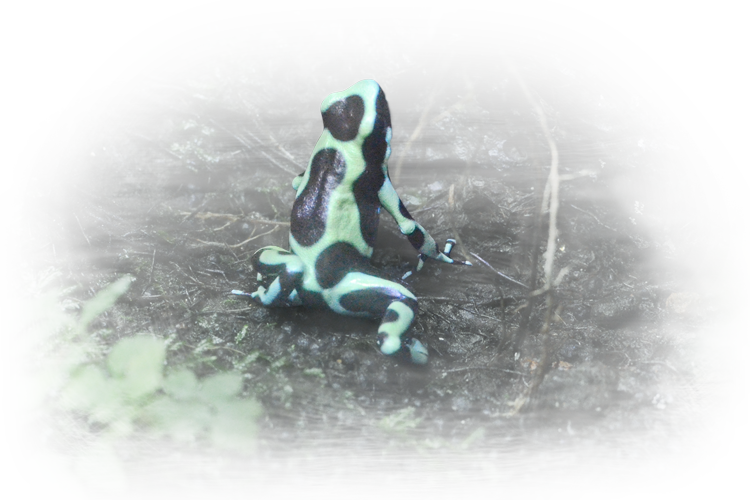
Dendrobates auratus (Girard, 1855)
森に散りばめられた色彩の毒
A Mosaic of Color and Poison in the Rainforest
体長2.5〜4cm。コスタリカ、コロンビア、ニカラグア南部、パナマ、ホンジュラスなど、中南米の熱帯雨林に生息します。ハワイのオアフ島では、1932年に蚊などの害虫駆除を目的として意図的に移入され、現在も定着した個体群が確認されています。
名前の通り、緑と黒のマダラ模様が基本ですが、地域や環境による地理的変異が非常に大きく、野生では15種類以上の異なる色彩・模様の形態が記録されています。これらの外観の違いはモルフと呼ばれ、青と黒、青とブロンズ色、迷路状の模様など、別種のように見えるほど多様です。そのためコレクター人気が高く、両生類の中ではメキシコサンショウウオ(Ambystoma mexicanum)に次いで、ペット取引量の多い種とされています。
皮膚には毒があり、現地ではこのカエル1匹から50本もの毒矢が作られたと伝えられています。毒素は主にダニやアリ、甲虫などの小型節足動物から得られ、これらが持つアルカロイド化合物を特殊な皮膚腺に隔離・蓄積します。そのため食性が変化すると毒性は失われ、飼育下で繁殖された個体の多くは無毒です。また、ハワイに移入された個体群も、餌環境の違いにより毒性は低いと考えられています。
繁殖期は熱帯雨林の雨季にあたる7月〜9月です。雄同士の縄張り争いが始まり、縄張りを確立した雄は「チーズチーズチーズチーズ」と聞こえるトリル状の鳴き声で雌を引き付けます。求愛が成立すると、雌は小さな水たまりにゼラチン状物質に包まれた卵を最大6個産み、雄はその直後に卵の上を歩いて外部受精を行います。約6週間後、孵化したオタマジャクシは雄の背中に乗せられ、捕食者の少ない安全な小さな水場へと運ばれます。
Adult body length ranges from 2.5 to 4 cm. This species inhabits tropical rainforests of Central America and northern South America, including Costa Rica, Colombia, southern Nicaragua, Panama, and Honduras. On the island of Oʻahu, Hawaiʻi, it was deliberately introduced in 1932 for mosquito control, and an established population still persists today.
As its common name suggests, the frog typically displays a green-and-black mottled pattern. However, it shows remarkable geographic variation, with more than 15 distinct color and pattern forms recorded in the wild. These external variations, commonly referred to as morphs, include combinations such as blue and black, blue and bronze, and maze-like patterns, some of which differ so greatly that they appear to be separate species. Owing to this diversity, the species is highly valued among collectors and is considered one of the most frequently traded amphibians in the pet market, second only to the axolotl (Ambystoma mexicanum).
The skin contains toxic compounds, and local traditions claim that a single frog was sufficient to poison as many as 50 blowgun darts. These toxins are not synthesized by the frog itself but are acquired from its diet, which consists mainly of small arthropods such as mites, ants, and beetles. Alkaloid compounds obtained from these prey items are sequestered and stored in specialized skin glands. Consequently, when the diet changes, toxicity is lost, and most captive-bred individuals are non-toxic. The introduced population on Hawaiʻi is also believed to exhibit reduced toxicity due to differences in available prey.
The breeding season coincides with the rainy season of tropical rainforests, typically from July to September. Males establish territories and engage in territorial disputes, after which a dominant male attracts females with a trilling call that resembles a repeated “cheese-cheese-cheese” sound. Following courtship, the female lays up to six eggs enclosed in a gelatinous mass in a small water-filled cavity. The male then fertilizes the eggs externally by walking over them. Approximately six weeks later, the hatched tadpoles are carried on the male’s back and transported to small, predator-free water bodies suitable for development.
参考文献
札幌市円山動物園 | 動物紹介 | マダラヤドクガエル 2026年1月1日閲覧
Ravage, Jeff (2019). Auratus Morphs. Auratus Morphs Resurrected. 2026年1月1日閲覧
The Environmental Literacy Council (2025). Does Hawaii have dart frogs? 2026年1月1日閲覧
Biology Insights (2025). The Science Behind Poison Dart Frog Toxin. 2026年1月1日閲覧
Animal Diversity Web (2025). Dendrobates auratus. 2026年1月1日閲覧
The Aquarium of the Pacific’s (2025). Green and Black Poison Dart Frog. 2026年1月1日閲覧