
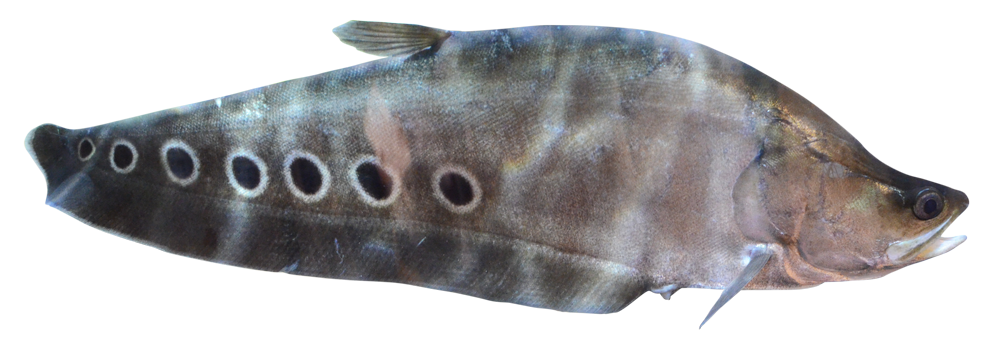
Chitala ornata J. E. Gray, 1831
連なる偽りの目を持つ古代魚
An Ancient Fish with a Row of False Eyes
スポッテッド・ナイフフィッシュは、東南アジアに生息するアロワナ目ナギナタナマズ科の淡水魚です。体長は最大で1mほどに達し、細長く側扁した体と、後方まで続く長い臀びれによって、まるで刃物のような独特の姿をしています。英名の「フェザーバック」は羽根のように波打つ臀びれに由来し、日本ではナギナタナマズの仲間として知られています。
本種の最大の特徴は、体の後半部に並ぶ大きな眼状斑です。黒い縁取りと淡色の輪を持つこの模様は、まるで複数の目が並んでいるように見え、捕食者を惑わせる役割を果たしていると考えられています。分布域はメコン川、チャオプラヤ川、メクロン川などの大河川流域に及び、流れの緩やかな河川や湖沼、水路などに生息します。また、観賞魚として世界各地に持ち込まれた結果、アメリカ・フロリダ州では外来種として定着し、スポーツフィッシングの対象にもなっています。
夜行性で、魚類や甲殻類、水生昆虫など口に入る大きさの動物を幅広く捕食します。幼魚は水面近くの流木や水草の周辺で身を隠して生活しますが、成長すると行動範囲を広げ、単独で活動するようになります。また、酸素の少ない環境に適応しており、水面で空気を取り込んで浮き袋による補助呼吸を行うことができます。この能力によって低酸素環境でも生存でき、季節によって水質や水位が大きく変化する東南アジアの水域で生き抜いてきました。古代魚の系統に属する本種は、独特の体形だけでなく、このような優れた環境適応能力にも大きな特徴があります。
The Spotted Knifefish, or Clown Featherback (Chitala ornata), is a freshwater fish belonging to the family Notopteridae within the order Osteoglossiformes. It inhabits Southeast Asia and can grow to about 1 meter in length. Its elongated, laterally compressed body and long anal fin extending nearly to the tail give it a distinctive knife-like appearance. The English name “featherback” refers to the graceful, feather-like undulations of this fin.
The species is best known for the series of large eye-like spots along the rear half of its body. These ocelli, outlined in black and surrounded by pale rings, resemble multiple eyes and are thought to help confuse potential predators. Its native range includes major river systems such as the Mekong, Chao Phraya, and Mae Klong rivers, where it inhabits slow-moving rivers, lakes, and canals. Through the aquarium trade, the species has been introduced to other parts of the world, and established populations now occur in Florida, where it is also sought after as a sport fish.
A nocturnal predator, the Spotted Knifefish feeds on a wide variety of animals, including fishes, crustaceans, and aquatic insects. Juveniles remain near floating logs and aquatic vegetation for protection, but adults expand their range and become largely solitary. The species is also adapted to oxygen-poor environments, periodically surfacing to gulp air and using its swim bladder as an accessory respiratory organ. This ability allows it to survive in waters where oxygen levels fluctuate seasonally. Although often regarded as a “living relic” among freshwater fishes, its remarkable environmental adaptability is just as noteworthy as its ancient lineage and unusual appearance.
参考文献
“Chitala ornata (GRAY, 1831) Clown Featherback” SERIOUSLY FISH 2024年12月7日閲覧
“Florida Invasive Species: Clown Knifefish” FLORIDA MUSEUM 2024年12月7日閲覧
“Clown fetherback” ANIMALIA 2024年12月7日閲覧