

Larus crassirostris (Vieillot, 1818)
人と共に生きるウミネコ
Black-tailed Gulls Living Alongside People
全長約45cm、翼開長約125cm。東アジアの沿岸部に分布するカモメ科の鳥です。体色は白く、背や翼の上面は黒灰色で、嘴は黄色をしています。姿形はカモメによく似ていますが、嘴の先端に赤と黒の斑があり、黄色い目の周囲には赤いアイリングが見られ、尾羽に黒い帯模様が入る点で区別できます。体格はウミネコの方がやや大きく、日本に冬鳥として飛来するカモメに対し、ウミネコは主に留鳥として一年を通して見られます。
カモメの鳴き声は「クゥークゥー」とカラスに似た声ですが、ウミネコは「ニャーニャー」と猫の鳴き声に似た声を出すことが特徴で、和名の由来にもなっています。近年では海に近い都市部のビル屋上などに営巣して繁殖する例が増え、鳴き声による騒音や糞害が問題となっています。屋上やベランダにテグスや防鳥ネットを設置する対策も行われていますが、別の建物へ移動することも多く、根本的な解決には至っていません。このような状況を受け、東京都では2022年に鳥獣保護管理事業計画を改定し、繁殖期でも都の許可のもとで卵や雛の捕獲を行えるようにし、専門業者による捕獲が実施されています。
本来の繁殖地は、孤立した島や岩場、崖など人が近づきにくい場所です。地面に浅いくぼみを作って海藻や草を敷いた巣を作り、集団で繁殖します。通常2〜3個の卵を産み、雌雄で抱卵し約1か月で孵化します。雛は吐き戻された魚類を与えられて成長し、外敵に対しては集団で威嚇する行動が見られます。青森県八戸市の蕪島は代表的な繁殖地で、1922年に国の天然記念物に指定されています。春には数万羽が飛来し繁殖コロニーを形成します。蕪島では豊漁をもたらす「神の使い」として古くから信仰され、人への警戒心が比較的弱く間近で観察できることから、人との共生が地域文化と自然保護の象徴的な存在となっています。
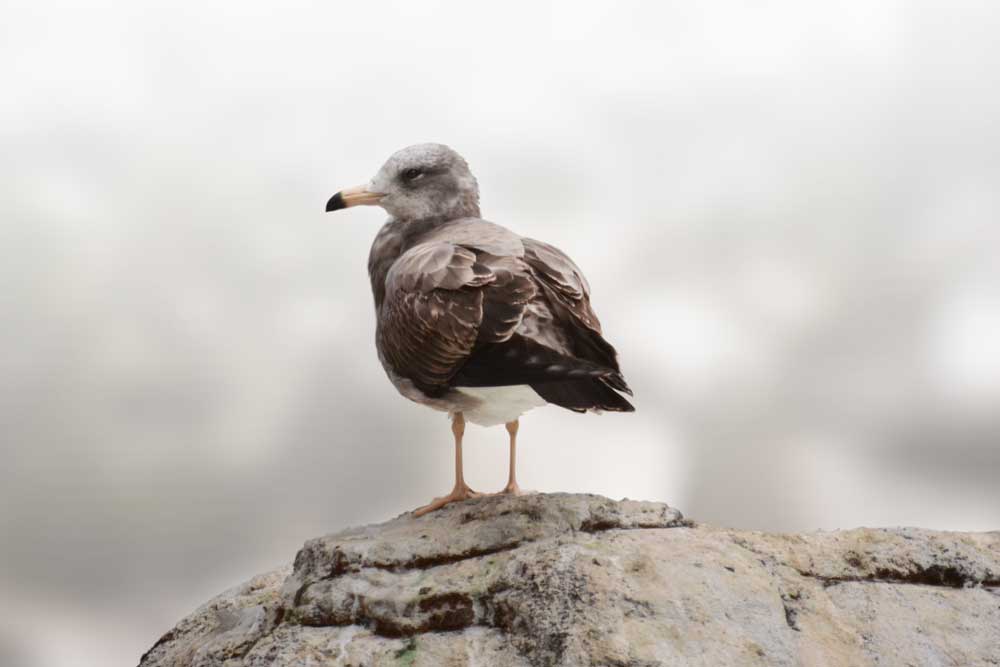
Young birds are covered with brown feathers
The Black-tailed Gull is a member of the gull family distributed along the coastal regions of East Asia. It measures about 45 cm in length with a wingspan of approximately 125 cm. Its body is mostly white, with dark gray upperparts on the back and wings, and a yellow bill. Although it closely resembles the Common Gull, it can be distinguished by the red and black markings on the tip of its bill, the red eye-ring surrounding its yellow eyes, and the black band across its tail feathers. The Black-tailed Gull is slightly larger in build, and while the Common Gull migrates to Japan as a winter visitor, the Black-tailed Gull is mainly a resident species and can be observed throughout the year.
The call of the Common Gull resembles the crow-like “kwee-kwee,” whereas the Black-tailed Gull produces a cat-like “nyaa-nyaa” call, which is the origin of its Japanese name. In recent years, they have increasingly nested on rooftops of buildings in coastal urban areas, where noise from their calls and damage caused by droppings have become social issues. Countermeasures such as installing wires or bird nets on rooftops and balconies have been implemented, but the birds often relocate to other buildings, making fundamental solutions difficult. In response to this situation, the Tokyo Metropolitan Government revised its Wildlife Protection and Management Plan in 2022, allowing the capture of eggs and chicks during the breeding season with official permission, and professional removal operations have been carried out.
Their natural breeding sites are isolated islands, rocky areas, and cliffs that are difficult for humans to access. They form breeding colonies by creating shallow ground nests lined with seaweed and grass. Typically, two to three eggs are laid, and both parents take turns incubating them for about one month. The chicks are fed regurgitated fish and grow rapidly, while adults collectively mob predators to increase breeding success. Kabushima in Hachinohe City, Aomori Prefecture, is one of the best-known breeding sites and was designated a National Natural Monument in 1922. Each spring, tens of thousands of birds arrive and form large breeding colonies. At Kabushima, the birds have long been revered as “messengers of the gods” believed to bring abundant catches of fish. Because they are relatively tolerant of humans and can be observed at close range, they have become a symbol of coexistence between people, local culture, and nature conservation.
参考文献
気仙沼観光推進機構 | 気仙沼さ来てけらいん | カモメ?ウミネコ?ボクのこと知ってるかな?| (2020年11月17日) 2026年2月14日閲覧
台東区 | ウミネコ被害の対策について | (2025年1月6日) 2026年2月14日閲覧
紺碧タイムズ | 東京の住民を悩ます海鳥 ウミネコ | 大桑海斗(2025年3月10日) 2026年2月14日閲覧
東京都環境局 | 「ウミネコの被害状況及び対策について」| (2021年12月1日) 2026年2月14日閲覧
VISIT HACHINOHE |「八戸本」編集部が紐解く!蕪島の歴史を徹底解剖 2026年2月14日閲覧
ロケットニュース24 | 【ニッポン珍景】数万羽のウミネコが埋め尽くす神秘の島「蕪島」!! フンをかぶったらいいことあるぞ | 冨樫さや (2024年7月21日) 2026年2月14日閲覧