
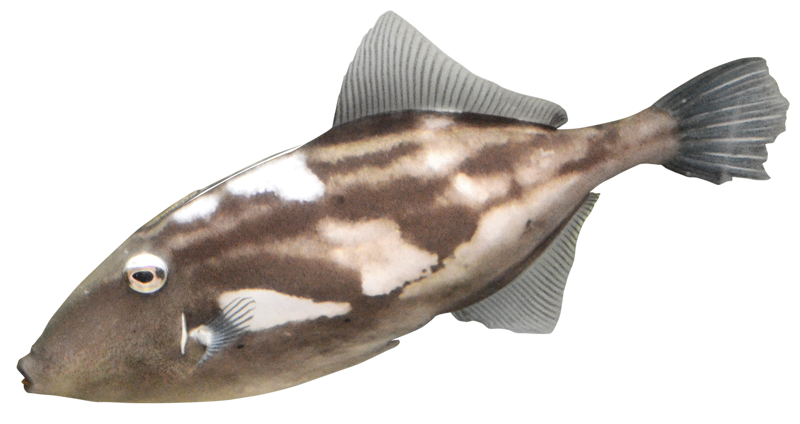
Thamnaconus modestus (Günther, 1877)
価値が高まるカワハギの代用品
A Reappraised Alternative to the Thread-sail Filefish
体長は最大で約35cm。北西太平洋の温帯域に広く分布し、東アジア沿岸に多く見られます。日本では北海道から九州にかけての沿岸に生息し、砂泥底や岩礁域など多様な環境に適応しています。地域によって成長速度に差があり、日本海産よりも東シナ海産の個体の方が成長が速い傾向があるとされています。
近縁種のカワハギ(Stephanolepis cirrhifer)によく似ていますが、カワハギが丸みのある体形であるのに対し、本種はやや細長く、吻部が前方へ突き出して馬の顔のように見えることから「ウマヅラハギ」の名が付けられました。なお、ウマヅラハギもカワハギ同様に皮を容易に剥ぐことができます。
本種は長らくカワハギの代用品として扱われてきましたが、近年ではその評価が見直されつつあります。身質は良好で旨味があり、肝も美味とされるなど食材としての価値は高い魚です。一方で、腸由来のアンモニア臭を発することでも知られていますが、これは釣獲後すぐに内臓を除去することで抑えることができます。そのため、鮮度保持には迅速な処理が重要とされています。
The black scraper (Thamnaconus modestus) is a filefish reaching a maximum length of about 35 cm. It is widely distributed in the temperate waters of the northwestern Pacific and is commonly found along the coasts of East Asia. In Japan, it occurs from Hokkaido to Kyushu, inhabiting a variety of environments including sandy-muddy bottoms and rocky reefs. Growth rates vary by region, with individuals from the East China Sea tending to grow faster than those from the Sea of Japan.
It closely resembles the thread-sail filefish (Stephanolepis cirrhifer), but whereas the latter has a deeper, more rounded body, this species is more slender, with an elongated snout that gives it a horse-like profile—hence the Japanese name “umazurahagi.” Like the thread-sail filefish, it can easily be skinned.
In Japan, although long regarded as a substitute for the thread-sail filefish, its value has been reassessed in recent years. Its flesh is of good quality and rich in flavor, and its liver is also considered a delicacy. On the other hand, it is known for producing a strong ammonia-like odor from the intestines; however, this can be suppressed by promptly removing the viscera after capture. Therefore, rapid processing is essential for maintaining freshness.
参考文献
新潟水族館マリンピア日本海 | 生物図鑑 | ウマヅラハギ 2025年1月19日閲覧
“Thamnaconus modestus (Günther, 1877) Black scraper” FishBase 2025年1月19日閲覧
JFいしかわ | いしかわの魚 | ウマヅラハギ 2025年1月19日閲覧
クラシル | 記事 | ウマヅラハギとは?カワハギとの違いやカロリー、おすすめレシピをご紹介! | (2023年3月30日) 2025年1月19日閲覧