
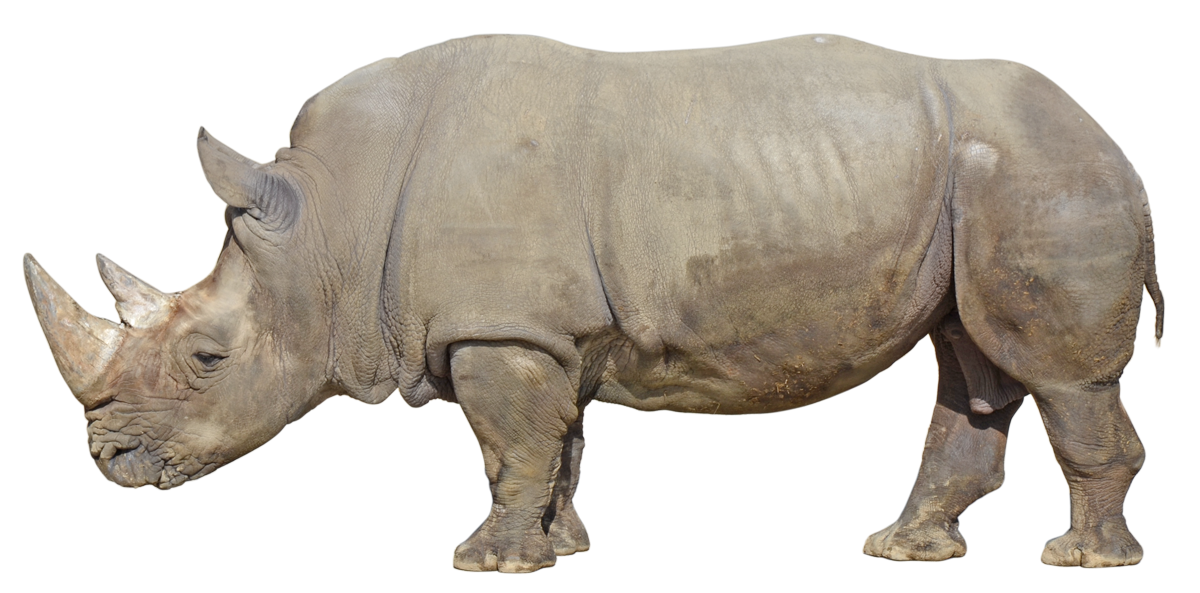
Ceratotherium simum (Burchell, 1817)
誤訳から生まれた名前
A Name Born from a Mistranslation
全長(頭胴長)335~420cm、尾長50~70cm、肩高171~185cm、体重はオス2,000~3,600kg、メス1,400~1,700kgに達する、現生するサイ類最大の種です。アフリカの草原やサバンナに生息し、低い草を主食としています。その巨体はアフリカゾウに次ぐ陸上哺乳類の大きさを誇り、堂々とした姿はサバンナを代表する動物の一つとして知られています。
シロサイの最大の特徴は、横に大きく広がった幅広い口です。この口は地面近くの草を効率よく刈り取るのに適応したもので、木の葉や枝を選んで食べるクロサイの尖った唇とは対照的です。なお、「シロサイ」という名前は体色に由来するものではありません。オランダ語で「広い」を意味する wijd(ワイド)に由来する呼称が英語に伝わる過程で「white」と誤解され、White Rhinoceros の名が定着したと考えられています。実際の体色は灰色で、クロサイとの間に明確な色の違いはありません。
性格は比較的おとなしく、危険を感じるとまずその場を離れようとします。しかし、その巨体からは想像しにくいほど俊敏で、最高時速50km近くで走ることができます。日中は木陰で休んだり泥浴びをしたりして過ごし、泥は体温の上昇を防ぐだけでなく、寄生虫や吸血昆虫から身を守る役割も果たしています。
頭部には2本の角があり、前方の角は60cm以上に達することもあります。角は骨ではなく、毛や爪と同じケラチンというタンパク質が束になってできたもので、一生伸び続けます。そのため木や岩などに擦り付けて角を削る行動がよく見られ、動物園でも観察することができます。
シロサイにはミナミシロサイとキタシロサイの2亜種が知られています。ミナミシロサイは保護活動によって個体数が回復した一方、キタシロサイは密猟によって激減し、現在はわずか2頭のメスしか残されていません。現在は体外受精や代理母出産といった最先端の生殖技術を用いて亜種の存続を目指す取り組みが進められており、その行方は世界中の注目を集めています。
The White Rhinoceros is the largest living species of rhinoceros. It measures 335–420 cm in head-body length, with a tail length of 50–70 cm and a shoulder height of 171–185 cm. Adult males weigh between 2,000 and 3,600 kg, while females weigh 1,400–1,700 kg. It inhabits grasslands and savannas across Africa and feeds primarily on short grasses. Its immense size makes it the second-largest land mammal after the African elephant, and its imposing appearance has made it one of the most iconic animals of the African savanna.
The most distinctive feature of the White Rhinoceros is its broad, square-shaped mouth. This adaptation allows it to graze efficiently on grasses growing close to the ground, in contrast to the pointed, prehensile lips of the Black Rhinoceros, which are adapted for browsing leaves and twigs. Despite its name, the White Rhinoceros is not actually white. The name is believed to have originated from the Dutch word wijd (“wide”), referring to its broad mouth. Through a misunderstanding during translation into English, the term eventually became “white.” In reality, its skin is gray, and there is little difference in coloration between white and black rhinoceroses.
Although generally regarded as relatively calm and less aggressive than the Black Rhinoceros, the White Rhinoceros can move with surprising speed. When threatened, it usually chooses to flee rather than confront danger directly, yet it is capable of reaching speeds of nearly 50 km/h. During the heat of the day, it often rests in the shade or wallows in mud. Mud helps regulate body temperature and provides protection against parasites and biting insects.
The head bears two horns, the front horn often exceeding 60 cm in length. Unlike the antlers of deer, rhinoceros horns are not made of bone but of keratin, the same protein found in hair and nails. Because the horns continue to grow throughout life, White Rhinoceroses frequently rub them against trees, rocks, and other hard surfaces, a behavior that helps maintain their shape and condition.
Two subspecies of White Rhinoceros are recognized: the Southern White Rhinoceros and the Northern White Rhinoceros. While conservation efforts have helped the Southern White Rhinoceros recover from near extinction, the Northern White Rhinoceros has been driven to the brink of extinction by poaching. Today, only two females remain alive. Scientists are now attempting to save the subspecies through advanced reproductive technologies, including in vitro fertilization and surrogate motherhood, making its future one of the most closely watched conservation efforts in the world.
参考文献
群馬サファリパーク | 動物紹介 | ミナミシロサイ 2024年8月4日閲覧
Tuttle, Jade. (2022, April 27) Abby the Rhino’s New Look. North Carolina Zoo. 2024年8月4日閲覧
静岡県立日本平動物園 | 動物紹介 | シロサイ 2024年8月4日閲覧