
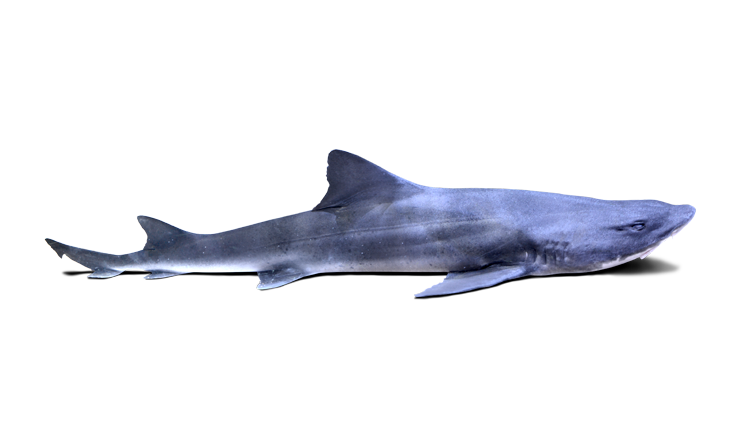
Triakis scyllium (Müller & Henle, 1839)
静かな海底に佇む温和なサメ
A Gentle Shark Lingering on the Quiet Seafloor
全長約1.5m。ロシア極東から日本、韓国、中国、台湾にかけての浅い沿岸域に生息します。体色は灰色から黒色で、幼魚には暗色の帯や斑点が見られますが、成長とともに次第に薄れていきます。名前の由来は神奈川県三崎地方の方言で、ドチとは「奴痴」と書き、愚か者や下等なものを意味するとされています。
性格は比較的おとなしく、人を襲うことはほとんどありません。目が大きく愛嬌のある姿から、水族館で飼育・展示されることも多い種です。夜行性で、日中は海底でじっとしていることが多く、ときには複数個体が重なり合って休む様子も観察されます。
繁殖様式はホホジロザメやジンベエザメと同様の卵胎生です。卵胎生とは、卵が母体内で孵化してから仔が生まれる方法で、サメ類にはこのほかに卵生や胎生があります。卵胎生では卵黄の栄養によって成長が促され、卵が外敵に襲われる危険が少なく、孵化環境も安定するため、仔魚の生存率が高まる利点があります。
東日本ではほとんど食用にされませんが、九州ではホシザメなどとともに「モダマ」の名で流通し、湯引きした状態で販売されます。淡白でクセのない味わいが特徴で、酢味噌和えとして食べられるのが一般的です。
This species grows to a total length of about 1.5 meters. It inhabits shallow coastal waters from the Russian Far East through Japan, Korea, China, and Taiwan. The body is gray to black in color. Juveniles display dark bands or spots, which gradually fade as they mature. The Japanese name “Dochizame” is derived from a dialect of the Misaki area in Kanagawa Prefecture; dochi, written as “奴痴,” historically referred to something foolish or inferior.
The banded houndshark is generally docile and rarely poses a threat to humans. Its large eyes and gentle appearance make it a popular species for exhibition in aquariums. Nocturnal by nature, it often remains motionless on the seafloor during the day, and multiple individuals may sometimes be observed resting together in close contact.
Reproduction occurs through ovoviviparity, the same reproductive mode seen in species such as the great white shark and the whale shark. In ovoviviparous species, eggs hatch inside the mother’s body before the young are born. Other reproductive strategies among sharks include oviparity, in which eggs are laid, and viviparity, in which embryos develop in the uterus. Ovoviviparity offers several advantages, including nourishment from the yolk, reduced risk of predation on eggs, and a stable developmental environment within the parent’s body, resulting in higher survival rates for the young.
Although the banded houndshark is rarely consumed in eastern Japan, it is eaten in Kyushu, where it is sold under the name modama along with species such as the starspotted smooth-hound. The meat is typically parboiled and is known for its mild, delicate flavor, most commonly enjoyed with vinegared miso.
“Banded houndshark” Allfishes. 2025年12月29日閲覧
あぶかも | モダマ三種 | (2009年1月20日) 2025年12月29日閲覧
ぼうずコンニャクの市場魚貝類図鑑 | ドチザメ 2025年12月29日閲覧
TSURIHACK | 簡単に釣れるベイシャーク!大都会に生息している“ドチザメ”の生態や釣り方 | (2025年2月23日) 2025年12月29日閲覧
浅野 長雄・藤本 武『茨城県産魚類の方言について/第1報・第2報』県立那珂湊水産高等学校 2025年12月29日閲覧
Knibb, Freya (2023, October 23) “6 Fun Facts About the Japanese Banded Houndshark” Bristol Aquarium. 2025年12月29日閲覧
チャーム | コラム | 卵胎生って要するにどういうこと?| (2022年7月21日) 2025年12月29日閲覧