
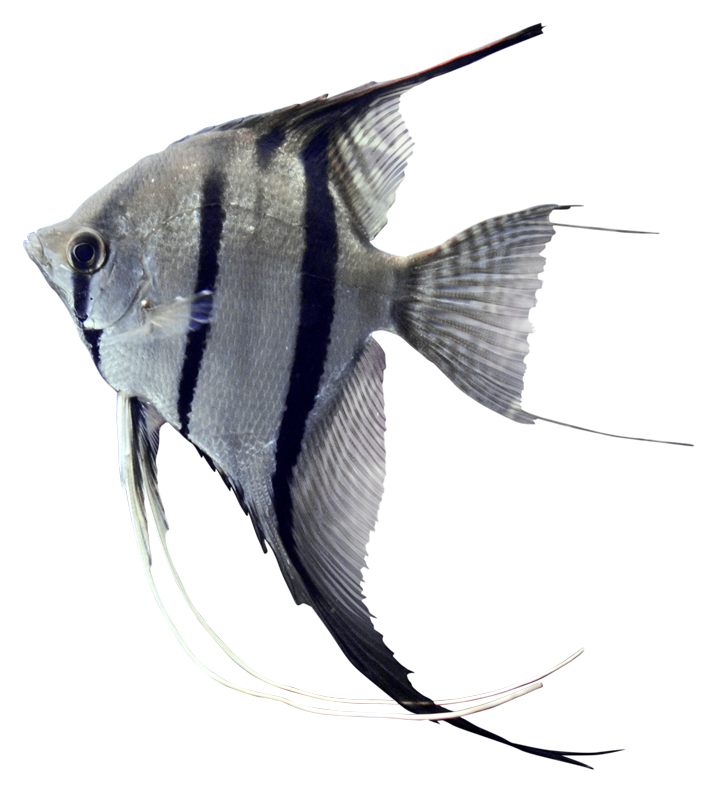
Pterophyllum scalare (Schultze, 1823)
熱帯魚の代名詞となるまでの200年
200 Years to Become an Icon of Tropical Fish
南アメリカ・アマゾン川水系原産の淡水魚で、全長12〜15cmほど。体は強く側扁し、背びれと尻びれ、さらに糸状に伸びる腹びれが優雅な姿を形作ります。大きなヒレを広げてゆったりと泳ぐ様子が天使を思わせることから名付けられ、熱帯魚の代名詞的存在として広く知られています。シクリッド科に属しますが、同科の中では比較的温和で飼育しやすく、体色や模様、ヒレの長さなど多様な改良品種が作出されています。なお英名“Angelfish”は海水魚のキンチャクダイ類を指す場合もあり、呼称の混同には注意が必要です。
現生のエンゼルフィッシュは一般に3種に分類され、最も普及しているスカラレ種、大型で体高のあるアルタム種、丸みを帯びた体形のデュメリリィ種が知られています。流通個体の多くはスカラレ種を基にした養殖品種です。なおスカラレ種の学名 Pterophyllum scalare の種小名「scalare」はラテン語で「梯子」を意味し、体側に並ぶ縦帯模様が梯子のように見えることに由来します。
本種は1823年にドイツの動物学者ハインリヒ・カール・リヒテンシュタインによって記載されました。1909年にヨーロッパへ導入された当初は輸送の困難さから高価な観賞魚でしたが、1915年以降アメリカで繁殖技術が確立されると次第に普及が進みました。第二次世界大戦後には輸送・飼育技術の向上により世界各地へ広まり、現在では広く親しまれる観賞魚となっています。近年は遺伝子研究も進み、品種改良の基盤となる遺伝的特徴の解明が進展しています。
A freshwater fish native to the Amazon River basin in South America, growing to about 12–15 cm in length. Its body is strongly laterally compressed, and its elongated dorsal and anal fins, along with thread-like pelvic fins, create an elegant silhouette. The name “angelfish” comes from its graceful manner of swimming with extended fins, resembling an angel. It is widely recognized as one of the most iconic tropical aquarium fishes. Although it belongs to the cichlid family, it is relatively peaceful compared to other members and is easy to keep. Numerous ornamental varieties have been developed, differing in coloration, pattern, and fin shape. Note that the English name “angelfish” may also refer to marine angelfishes (family Pomacanthidae), which can cause confusion.
Extant angelfishes are generally classified into three species: the most common Pterophyllum scalare, the large and tall-bodied P. altum, and the more rounded P. leopoldi. Most individuals in the aquarium trade are cultured strains derived from P. scalare. The specific name “scalare” is derived from the Latin word for “ladder,” referring to the vertical bands on the body that resemble the rungs of a ladder.
This species was first described in 1823 by the German zoologist Heinrich Karl Lichtenstein. It was introduced to Europe in 1909, but was initially expensive due to the difficulty of long-distance transport. After breeding techniques were established in the United States around 1915, it became more widely available. Following World War II, improvements in transportation and husbandry led to its global spread, and it is now one of the most popular ornamental fishes worldwide. In recent years, genetic studies have advanced, improving our understanding of traits underlying selective breeding.
参考文献
Psaradelis, Sarah (2024, August 12). “9 Amazing Facts About Angelfish: Species, Lifespan & More”. Pango Vet. 2024年9月16日閲覧
Pet Pedia | カラフルな人気熱帯魚、エンゼルフィッシュの魅力と飼い方 2024年9月16日閲覧
エンゼルフィッシュ.jp | 飼育マニュアル | 第1章 エンゼルフィッシュってどんな魚? 2024年9月16日閲覧
“Angel fish history” USA FishBox. (2011,January 20) 2025年5月25日閲覧
“High school student is first to sequence the angelfish genome” New Scientist. (2022,October 21) 2025年5月25日閲覧