
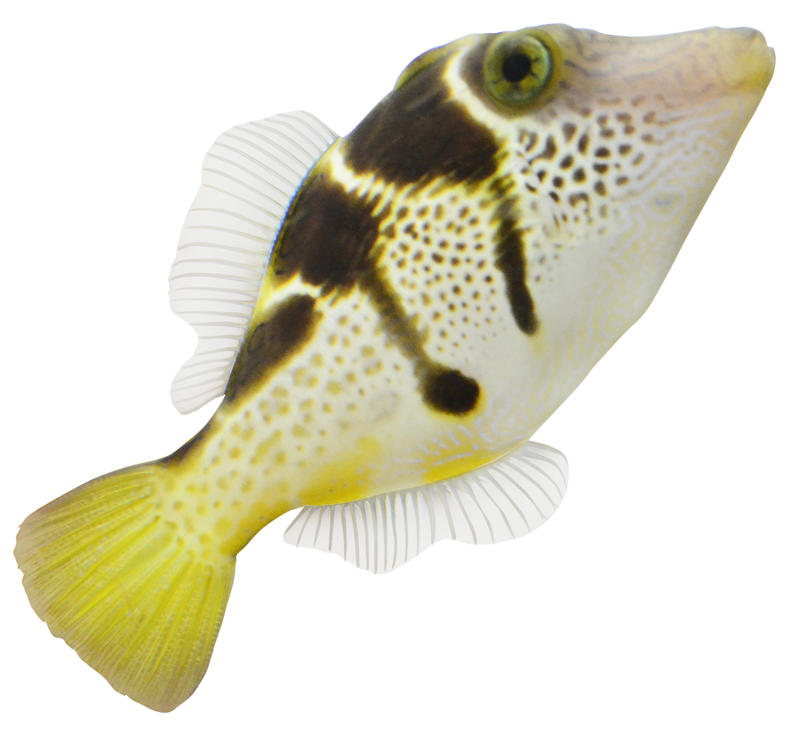
Paraluteres prionurus (Bleeker, 1851)
有毒種に似せた擬態の妙
The Art of Mimicking a Toxic Species
体長は最大11cm。インド・西太平洋の熱帯域に分布するカワハギ科の魚です。英名の「False puffer(偽のフグ)」が示すように、フグによく似た姿をしています。なかでもそっくりなのが、毒をもつシマキンチャクフグです。
ノコギリハギは、シマキンチャクフグの体色や模様、体形までよく似せることで、捕食者から身を守っていると考えられています。無毒で食べられる動物が、毒や危険性をもつ別の動物に似ることで捕食を避ける現象を「ベイツ型擬態」といいます。実際に野外で行われた実験では、シマキンチャクフグに似た模様をもつ模型ほど捕食魚が近づきにくくなり、擬態による防御効果が示されています。
しかし、よく見ると両者には違いがあります。特に分かりやすいのが背鰭と臀鰭です。ノコギリハギではこれらの鰭が大きく、体の後半に沿って長く伸びています。一方、シマキンチャクフグの背鰭と臀鰭は小さく、ノコギリハギほど目立ちません。
ノコギリハギは単独または小さな群れで暮らし、成魚ではペアで見られることもあります。魚卵や小型の巻貝などを食べ、海底の表面をついばみながら餌を探します。毒をもつフグそっくりの姿は、単なる偶然ではなく、捕食者との長い関係の中で進化した「身を守るための姿」といえるでしょう。
Growing to about 11 cm in length, the false puffer is a member of the filefish family found in tropical waters of the Indian and western Pacific oceans. As its English name, “false puffer,” suggests, it closely resembles a pufferfish. Most notably, it looks remarkably similar to the toxic Valentin’s sharpnose puffer.
The false puffer is thought to protect itself from predators by closely imitating the Valentin’s sharpnose puffer in body shape, coloration, and pattern. When a harmless and edible animal resembles another animal that is toxic or dangerous, thereby reducing the risk of being eaten, this form of mimicry is known as Batesian mimicry. Field experiments have shown that predatory fish are less likely to approach models with patterns resembling those of the Valentin’s sharpnose puffer, providing evidence that the mimicry can offer effective protection.
However, the two species can be distinguished by several features, particularly their dorsal and anal fins. In the false puffer, these fins are relatively large and extend along much of the rear part of the body. In contrast, the dorsal and anal fins of the Valentin’s sharpnose puffer are much smaller and less conspicuous.
The false puffer is usually found alone or in small groups, while adults may also be seen in pairs. It feeds on fish eggs, small snails, and other small prey, picking food from surfaces as it forages. Its resemblance to a toxic pufferfish is more than a coincidence: it can be seen as an adaptation shaped over generations of interaction with predators—a remarkable form that helps the fish avoid becoming prey.
参考文献
WEB魚図鑑 | ノコギリハギ 2025年2月16日閲覧
東京ズーネット | ニュース | ノコギリハギの生き方 2025年2月16日閲覧
酒井商店 | ふぐマガ | ふぐのふりして身を守る? ノコギリハギの不思議な生態 | (2023年7月24日) 2025年2月16日閲覧
朝日新聞デジタル | ひろしま案内人 | 自然生き抜く 擬態の妙 | 古本 哲史 (2022年6月5日) 2025年2月16日閲覧