
Parupeneus barberinoides (Bleeker, 1852)
派手なオジサンはインドから来た?
Did This Colorful Goatfish Come from India?
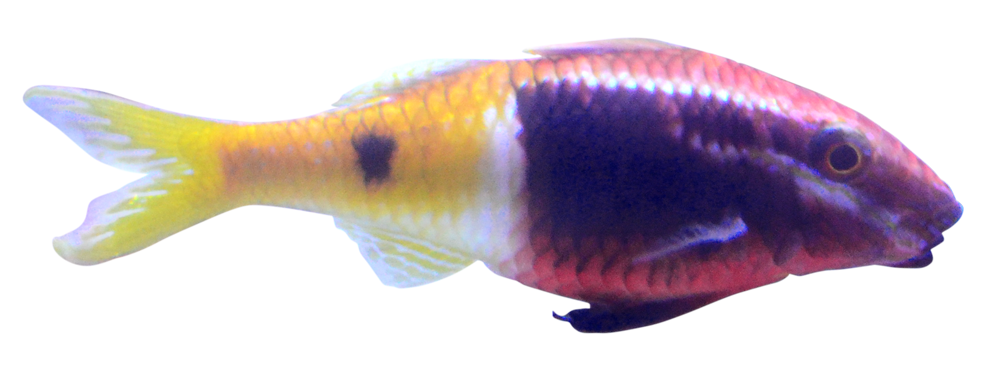
体長は約20cm。西太平洋の温帯域に広く分布し、岩礁やサンゴ礁、およびその周辺の砂底に生息します。ふだんは単独で行動することが多いものの、まれに数匹でゆるやかな群れを形成することもあります。体色は非常に特徴的で、頭部から腹部にかけては葡萄色を帯び、そこに2本の白い縦縞が入ります。体の後半は白から黄色へと移行し、全体としてコントラストの強い鮮やかな色彩を呈します。
口元に発達した一対のヒゲを持つ姿は「オジサン」によく似ていますが、いずれもヒメジ科に属する近縁な仲間です。本種もまた、その名に劣らぬ派手な外見を持ち、アゴのヒゲ(口ひげ)は感覚器として機能し、砂中に差し入れて小型の甲殻類や多毛類などの餌を探るのに用いられます。このヒゲは触覚だけでなく味覚も兼ね備えていると考えられています。
沖縄ではヒメジ科の魚類を総称して「かたかし」と呼び、3属およそ20種が確認されています。なお、本種は「インドヒメジ」という和名を持ちながら、インド近海には分布していません。命名の由来は明らかではありませんが、産地の記載ミスや、近縁種コバンヒメジ(Parupeneus indicus)との混同に由来する可能性も指摘されています。
The Bicolor goatfish reaches a total length of about 20 cm. It is distributed widely in the temperate regions of the western Pacific, inhabiting rocky reefs, coral reefs, and the surrounding sandy bottoms. Although it is most often seen alone, it occasionally forms small, loose groups. Its coloration is highly distinctive: the head and anterior body are tinged with a grape-like hue, marked by two white longitudinal stripes, while the posterior body transitions from white to yellow, creating a striking contrast.
Its appearance, with a pair of well-developed chin barbels, resembles that of the fish commonly known as “Ojisan,” but both belong to the same family, Mullidae. Like its relative, this species is also vividly colored, and its barbels function as sensory organs. These are used to probe into the sand in search of prey such as small crustaceans and polychaete worms, and are thought to play a role in both touch and taste.
In Okinawa, fishes of the family Mullidae are collectively known as “katakashi,” and around 20 species in three genera have been recorded. Despite its Japanese name, the Bicolor goatfish does not occur in waters near India. The origin of this name remains unclear, but it has been suggested that it may stem from a misrecording of locality or confusion with a related species, the Indian goatfish (Parupeneus indicus).
参考文献
鳥羽水族館 | 生きもの図鑑 | インドヒメジ 2024年12月1日
FishBase | Parupeneus barberinoides (Bleeker, 1852) Bicolor goatfish 2024年12月1日
「おきなわのいまいゆ Vol. 2 かたかし①(ヒメジ科)」 (2016年5月) 沖縄県水産海洋技術センター 2024年12月1日