
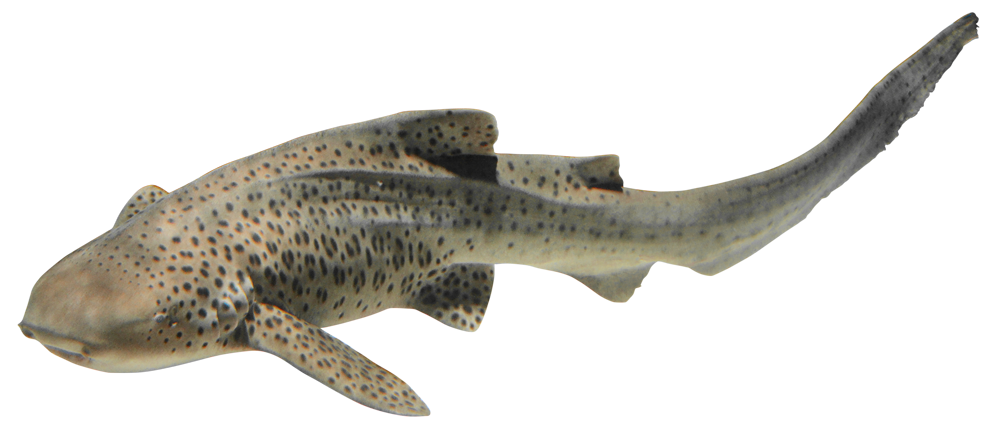
Stegostoma fasciatum (Hermann, 1783)
豹柄なのに何故虎なのか
Why a Tiger When It Has Leopard Spots?
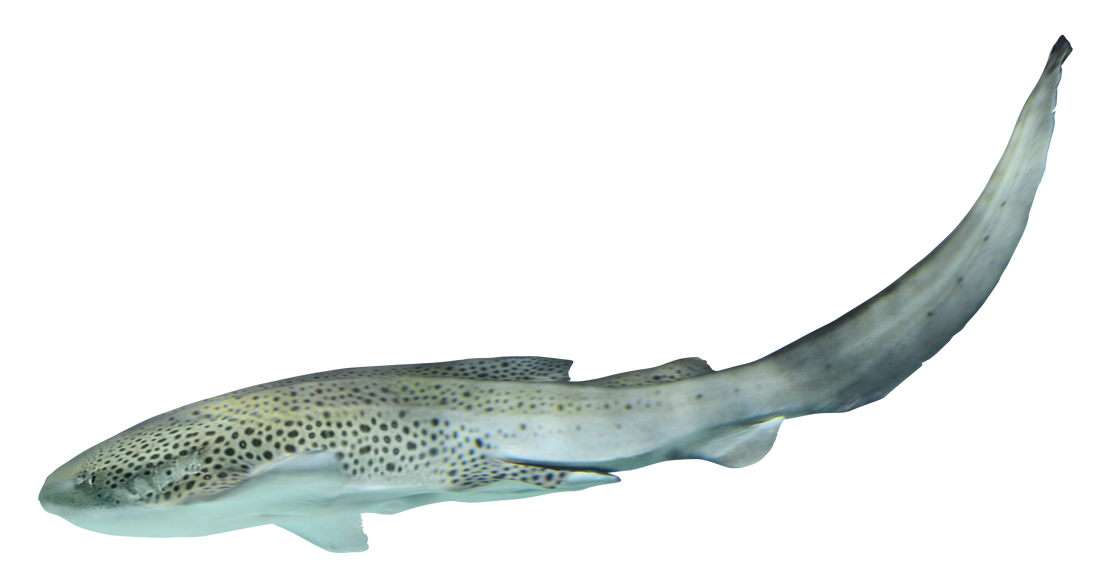
インド太平洋の熱帯から亜熱帯に広く分布し、沿岸のサンゴ礁や砂地など、主に水深60m以浅の海底に生息する大型のサメです。成体は全長約3.5mに達し、細長い体と長い尾を持ちます。体色は薄黄色から黄褐色で、全身に黒い斑点が散らばります。その姿はむしろヒョウ柄を思わせますが、名前には「トラ」が付いています。なぜでしょうか。
その理由は、幼体の姿にあります。孵化したばかりの幼体は、成体の斑点模様とはまったく異なり、濃い色の縦縞を持っています。この縞模様がシマウマを思わせることから、英名はZebra shark(ゼブラシャーク)と呼ばれます。和名の「トラフザメ(虎斑鮫)」も、この幼体の縞模様に由来します。成長すると縞模様は次第に失われ、斑点へと変化します。あまりにも姿が違うため、かつては幼体と成体が別の種類だと考えられていたほどです。
トラフザメは卵を産むサメで、メスは長さ17cmほどにもなる大型で丈夫な卵嚢を産みます。卵嚢には毛のような糸状の構造があり、それが岩やサンゴなどに絡みつくことで海底に固定されます。孵化までにはおよそ5~6か月を要します。幼体は成体とは異なる縞模様を持ち、体を左右に波打たせるように泳ぐため、その姿は海中を進むウミヘビのようにも見えます。
成体は主に夜間に活動し、海底をゆっくり移動しながら餌を探します。貝類、エビやカニなどの甲殻類、小型の硬骨魚、その他の底生動物などを食べます。大型のサメですが性質は比較的おとなしく、ダイバーに対して攻撃的になることはほとんどありません。昼間は海底で静かに休んでいることが多く、夜になると長い体と尾を使って海底を這うように移動します。
さらに、この種には姿だけでなく繁殖にも興味深い特徴があります。メスだけで子孫を残す「単為生殖」が確認されているのです。水族館などでオスと接触していないメスから幼体が生まれた例があり、通常の有性生殖とは異なる繁殖が可能であることが分かっています。個体数が少なく、繁殖相手と出会うことが難しい状況では、この能力が子孫を残すための一つの手段になる可能性があります。ただし、野生下でどの程度利用されているのかなど、まだ分かっていないことも多くあります。サメ類では、トラフザメのほかにもツマグロやシュモクザメ類、テンジクザメ類などで単為生殖が確認されています。
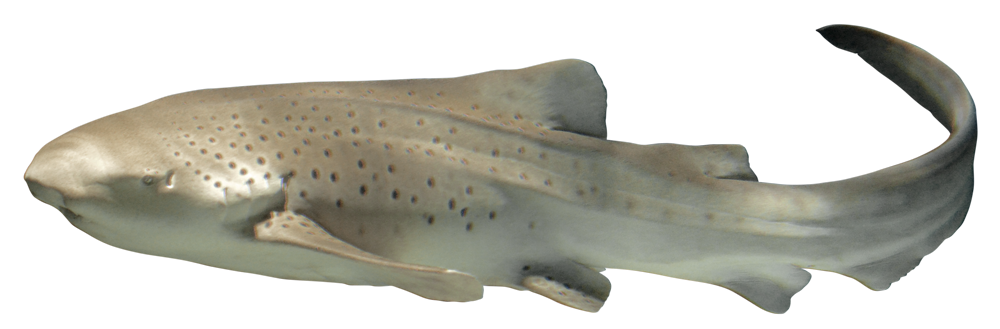
The zebra shark is a large shark widely distributed throughout the tropical and subtropical Indo-Pacific. It inhabits coastal coral reefs, sandy bottoms, and other shallow seafloor habitats, generally at depths of less than 60 meters. Adults can reach about 3.5 meters in total length and have a slender body and long tail. Their bodies are pale yellow to yellowish brown, covered with numerous dark spots. Their appearance resembles a leopard more than a tiger, so why does its Japanese name contain the word “tiger”?
The answer lies in its appearance as a juvenile. Newly hatched juveniles have bold dark longitudinal stripes, completely different from the spotted pattern of adults. Because these stripes resemble those of a zebra, the species is known in English as the Zebra shark. The Japanese name Torafu-zame, literally “tiger-patterned shark,” also refers to the striped pattern of the young. As the shark grows, the stripes gradually disappear and are replaced by spots. The difference is so striking that juveniles and adults were once thought to represent separate species.
The zebra shark is an egg-laying shark. Females produce large, tough egg cases that can reach about 17 centimeters in length. Hair-like filaments on the egg cases become entangled with rocks and corals, anchoring them to the seafloor. Hatching takes approximately five to six months. The young retain their distinctive stripes and swim by undulating their bodies from side to side, giving them an appearance somewhat like a sea snake moving through the water.
Adults are mainly nocturnal and search for food by slowly moving across the seafloor. Their diet includes mollusks, crustaceans such as shrimp and crabs, small bony fishes, and other bottom-dwelling animals. Despite their large size, they are relatively docile and are rarely aggressive toward divers. During the day, they often rest quietly on the seafloor, while at night they move along the bottom using their long bodies and tails.
The species also has an intriguing reproductive ability. Females can produce offspring through parthenogenesis, without mating with a male. Cases have been documented in aquariums in which females that had not been exposed to males produced young, demonstrating that reproduction can occur through a mechanism other than ordinary sexual reproduction. This ability may provide a means of producing offspring when populations are sparse and opportunities to encounter mates are limited, although how often parthenogenesis occurs in the wild remains unclear. Parthenogenesis has also been documented in other sharks, including blacktip reef sharks, hammerhead sharks, and wobbegongs.
参考文献
ナショナルジオグラフィック | 動物大図鑑 | トラフザメ | (2023年4月6日) 2024年7月13日閲覧
NEWSWEEK(ニューズウィーク日本版) | 「人魚の財布」からトラフザメが出てくる瞬間 | (2021年11月15日) 2024年7月13日閲覧
“Zebra Shark, Stegostoma tigrinum (Forster 1781)” Fishes of Australia. 2025年3月29日閲覧
美ら海水族館 | 美ら海だより | これからが旬です! | (2016年4月26日) 2025年3月29日閲覧
ナショナルジオグラフィック | ニュース | ホテルのサメが4年連続“処女懐胎” | (2012年1月9日) 2025年3月29日閲覧