
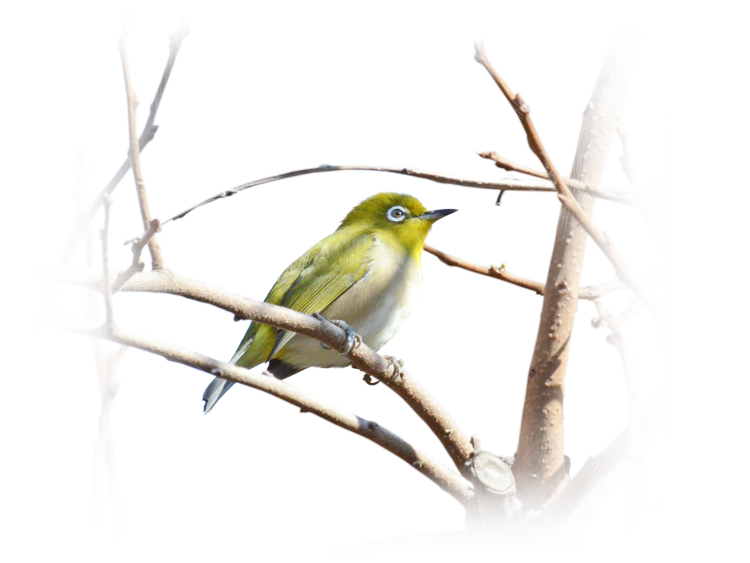
Zosterops japonicus (Temminck & Schlegel, 1845)
花咲く木々に映える鶯色とは?
What Does “Uguisu-iro” Mean in Blooming Trees?
全長約12cm。スズメよりひとまわり小さく、目の周りを縁取る白い羽毛が名前の由来となっています。体色は鮮やかな抹茶色で、この色を鶯(ウグイス)色と呼ぶことが多いことからウグイスと混同されがちですが、実際のウグイスはより地味で、茶色味を帯びた淡い緑灰色をしています。ウグイスは「ホーホケキョ」という印象的な鳴き声で知られていますが、メジロも繁殖期の春には「チュチュチュ」「キュリリリ」と澄んだ美しい声を響かせます。
メジロはかつて日本において、観賞用として捕獲が認められていた唯一の野鳥でした。都道府県の許可を得れば1世帯1羽のみ飼育が可能でしたが、密猟を助長するおそれがあるとして、2011年より原則禁止されています。密猟の背景のひとつには、鳴き声の優劣を競う「鳴き合わせ会」の存在があります。優勝個体が高値で取引されるようになり、風雅な文化行事であったはずの品評会は、次第に金銭目的へと変質していきました。
メジロは群れで行動し、枝に身を寄せ合って並ぶ習性から「目白押し」という言葉が生まれました。花の蜜や果汁など甘いものを好み、ウメやサクラ、ツバキ、サザンカの花を訪れるほか、カキやミカンなどの果実も食べます。「はなすい」「はなつゆ」といった別名があるように、花との結びつきが深い鳥で、昆虫が少ない冬季には花粉媒介者として重要な役割も果たしています。
The Japanese White-eye is a small passerine bird measuring about 12 cm in length, slightly smaller than a sparrow. Its most distinctive feature is the conspicuous white eye-ring, from which its name is derived. The plumage is a vivid yellowish green, often referred to in Japanese as “uguisu-iro” (bush warbler green), which has led to frequent confusion with the Japanese Bush Warbler. In reality, the bush warbler has much duller plumage, characterized by pale grayish green with brownish tones. While the bush warbler is famous for its clear “ho-ho-kekyo” song, the Japanese White-eye also produces pleasant vocalizations, such as “chu-chu-chu” and “kyuririri,” especially during the spring breeding season.
The Japanese White-eye was once the only wild bird in Japan legally permitted for capture and keeping as a songbird. With permission from local authorities, households were allowed to keep one individual. However, due to concerns that this practice encouraged poaching, capture and keeping have been principally prohibited since 2011. One factor behind illegal trapping was the existence of singing competitions known as naki-awase-kai, where birds were judged by their songs. Prize-winning individuals came to be traded at high prices, and what had once been a refined cultural pastime gradually shifted toward commercial exploitation. In the Showa era, it was not uncommon to see children catching white-eyes with birdlime, but today the capture or unlicensed keeping of wild individuals is strictly prohibited by law.
Japanese White-eyes are highly social birds, and their habit of crowding closely together on branches gave rise to the Japanese expression mejiro-oshi, meaning “packed tightly together.” They favor sweet foods such as flower nectar and fruit juice, frequently visiting the blossoms of plum, cherry, camellia, and sasanqua, as well as feeding on fruits like persimmons and mandarins. Reflecting this close association with flowers, the species is also known by the names hanasui and hanatsuyu. During winter, when insects are scarce, the Japanese White-eye plays an important ecological role as a pollinator.
参考文献
森と水の郷あきた | 野鳥シリーズ19 メジロ 2026年1月25日閲覧
日本経済新聞 | メジロ捕獲、原則禁止に 環境省が指針 | (2011年7月13日) 2026年1月25日閲覧
環境省 | やんばる国立公園 | メジロの密猟疑いの報告が多発しています(注意喚起)| (2019年6月18日) 2026年1月25日閲覧
全国区野鳥密猟対策連絡会 | 全国メジロ鳴き合わせ会情報 2026年1月25日閲覧
弁護士ドットコム ニュース | 美しく鳴く「メジロ」の飼育は違法?「鳴き合わせ会」メンバーはなぜ摘発されたのか | (2015年3月26日) 2026年1月25日閲覧
長老大学 | 聞き書き | モチの木でメジロを捕まえる(今は違法です)| (2014年11月9日) 2026年1月25日閲覧