
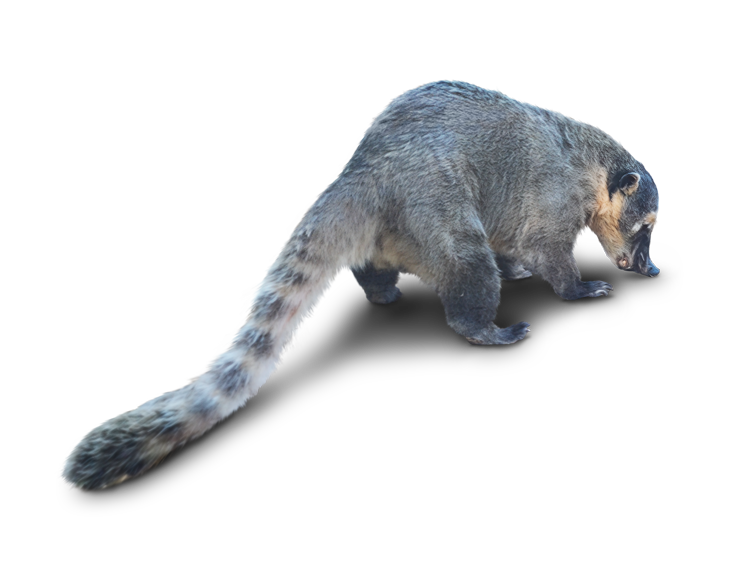
Nasua nasua (Linnaeus, 1766)
樹上は雌だけのサンクチュアリー
The Canopy as a Sanctuary for Females
体長40〜65cm。長い尾は体長とほぼ同じ長さで、尾を含めた全長は85〜115cmになります。アライグマ科ハナグマ属の代表的な種で、中米から南米北部にかけて広く分布し、森林や草原、農耕地周辺など多様な環境に適応しています。体色は赤褐色から灰褐色で、目の周囲が濃く見える覆面状の顔つきが特徴です。柔軟でよく曲がる長い鼻先は嗅覚に優れ、落ち葉の下に隠れた昆虫や小動物、果実などを探し出すのに役立っています。
ずんぐりとした体つきながら運動能力は高く、縞模様のある長い尾で巧みにバランスを取りつつ、地上と樹上を自在に移動します。前肢の筋肉がよく発達しており、足首は二重関節構造で約180度回転するため、木を頭から下ることも可能です。樹上は移動や休息だけでなく、交尾や出産の場としても利用され、捕食者から逃れるための重要な生活空間となっています。
同じアライグマ科に属するアライグマが夜行性で単独行動を基本とするのに対し、アカハナグマは日中に活動し、複数個体で行動する社会性を発達させました。活動時間帯や天敵の種類、餌資源の利用方法といった環境条件の違いが、こうした行動様式の差を生み出したと考えられています。
4〜20頭ほどからなる「バンド」と呼ばれる群れは、雌と若い個体のみで構成されます。雄は2歳前後になると群れを離れて単独生活に入り、繁殖期のみ群れに加わります。この雌雄で大きく異なる社会構造のため、かつて単独行動する雄は別種と誤って記載されたことがあり、グアラニー語で「孤独なハナグマ」を意味する別名「コアティムンディ(Coatimundi)」は、その名残とされています。
The red-nosed coati has a body length of 40–65 cm, and its long tail is nearly equal in length to its body, giving a total length of 85–115 cm including the tail. It is a representative species of the genus Nasua in the family Procyonidae, distributed widely from Central America to northern South America. Its fur ranges from reddish-brown to grayish-brown, and it is characterized by a mask-like facial pattern around the eyes. The long, flexible snout is highly sensitive and well adapted for locating insects, small animals, and fruits hidden beneath leaf litter.
Despite its stocky build, the coati is highly agile. Using its long, ringed tail for balance, it moves skillfully both on the ground and in trees. The forelimb muscles are well developed, and the ankle joints can rotate nearly 180 degrees, allowing the animal to descend trees headfirst. Trees serve not only as routes of movement and resting places but also as important sites for mating and giving birth, offering protection from predators.
While raccoons, close relatives within the same family, are primarily nocturnal and tend to live solitarily, red-nosed coatis are diurnal and have evolved a more social lifestyle. Differences in activity patterns, predator pressure, and feeding strategies are thought to have shaped these contrasting behaviors.
Groups known as “bands,” consisting of approximately 4 to 20 individuals, are made up of females and young. Males leave the group at around two years of age and thereafter live alone, joining bands only during the breeding season. Because of this pronounced difference in social structure between the sexes, solitary males were once mistakenly described as a separate species. The alternative name “coatimundi,” meaning “lone coati” in Guaraní, remains as a legacy of this early misunderstanding.
参考文献
ナショナルジオグラフィック | 動物大図鑑 | ハナグマ 2026年2月8日閲覧
Gallagher, Katherine (2024, July 23) “11 Interesting Coatimundi Facts” Treehugger, People Inc. 2026年2月8日閲覧
“Coatis” The Gale Encyclopedia of Science, Encyclopedia.com. 2026年2月8日閲覧