
Potamochoerus porcus (Linnaeus, 1758)
奇抜なイノシシが仲間を救う?
Can an Unusual Wild Hog Save Its Kind?
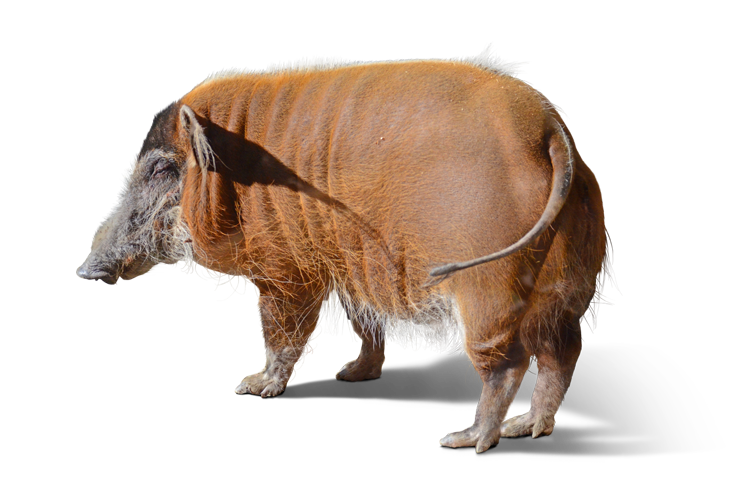
アフリカ西部および中央部の熱帯雨林地帯に生息するイノシシです。体長は100〜130cm、体重は45〜130kgで、河川や湿地など水辺環境を好んで暮らします。名前から赤い川に生息すると思われがちですが、正しくは赤褐色の体色を持つ川辺に棲むイノシシを意味します。ニホンイノシシよりも体つきはスマートで、特徴的な外見をしています。大きな耳の先端には長い房毛が生え、背中には一筋の白い線が入ります。雄のみ細長い鼻の両側に2つのイボを持ち、雄同士のテリトリー争いの際には防御の役割を果たします。
通常は1頭の雄を中心としたハーレムを形成し、複数の雌と若い個体を含む4〜20頭ほどの群れで生活します。繁殖期は9月から4月頃で、妊娠期間は120〜130日です。1回の出産で3〜6頭の幼体が生まれ、ニホンイノシシと同様に「ウリ坊」と呼ばれる縦縞模様を持ちます。日中は休息していることが多い一方、夜間は活発に行動し、長い鼻を器用に使って土を掘り返しながら餌を探します。主に草や根、昆虫などを食べますが、雑食性で見つけられるものは幅広く摂取します。
現在、世界の養豚業で深刻な問題となっているアフリカ豚熱ウイルス(ASFV)に対し、アカカワイノシシは感染しても発症しない自然宿主であることが知られています。無症状のままウイルスを保持し、媒介者であるダニにウイルスを供給する役割を担う可能性があるため、管理には注意が必要です。致死率が極めて高いこのウイルスには有効な治療法が確立されておらず、現状では感染の拡大を防ぐための防疫措置が中心となります。アカカワイノシシの免疫機構は直接治療に利用できる段階には至っていませんが、将来的な治療法やワクチン開発に向けた重要な手がかりになると期待されています。
The Red River Hog inhabits tropical rainforest regions of western and central Africa. It measures 100–130 cm in body length and weighs between 45 and 130 kg, favoring environments near rivers and wetlands. Despite its name, it does not live in “red rivers”; rather, the name refers to a river-dwelling hog with a reddish-brown coat. Compared with the Japanese wild boar, it has a more slender build and a distinctive appearance. Its large ears are tipped with long tufts of hair, and a single white stripe runs along its back. Only males possess two wart-like swellings on either side of the elongated snout, which serve a defensive function during territorial disputes with other males.
Red River Hogs typically form harems centered around a single male, living in groups of approximately 4 to 20 individuals that include multiple females and juveniles. The breeding season generally lasts from September to April, with a gestation period of 120–130 days. Each litter consists of three to six piglets, which, like those of the Japanese wild boar, display characteristic longitudinal stripes known as “uribō” in Japanese. While they often rest during the daytime, they become active at night, skillfully using their long snouts to dig through the soil in search of food. Their diet consists mainly of grasses, roots, and insects, but as omnivores they consume a wide variety of available food items.
The African swine fever virus (ASFV), which currently poses a serious threat to the global pig industry, is known to infect Red River Hogs without causing clinical disease. As natural hosts, they can carry the virus asymptomatically and may serve as a source of infection for vector ticks, making careful management essential. Because this virus has an extremely high mortality rate in domestic pigs and no effective treatment has been established, current control measures focus solely on preventing its spread. Although the immune mechanisms of the Red River Hog cannot yet be directly applied to treatment, they are expected to provide important insights for future therapeutic and vaccine research.
参考文献
Smithsonian’s National Zoo and Conservation Biology Institute. (n.d.). Red River hog. 2025年1月25日閲覧
Royal Zoological Society Scotland. (n.d.). Red River hog. 2025年1月25日閲覧
Pilcher, Helen (2023, December 11) “World’s weirdest animals: Meet the tasselled red river hog, nature’s most dapper swine” BBC Science Focus. 2025年1月25日閲覧
科学バー | ウイルスという存在ーヒトの進化にどうかかわってきたのかー | 第26話 内在性ウイルス | 長谷川政美 2025年1月25日閲覧
農研機構 | プレスリリース | アカカワイノシシ由来の新しい細胞株を樹立 | (2024年11月19日) 2025年1月25日閲覧