
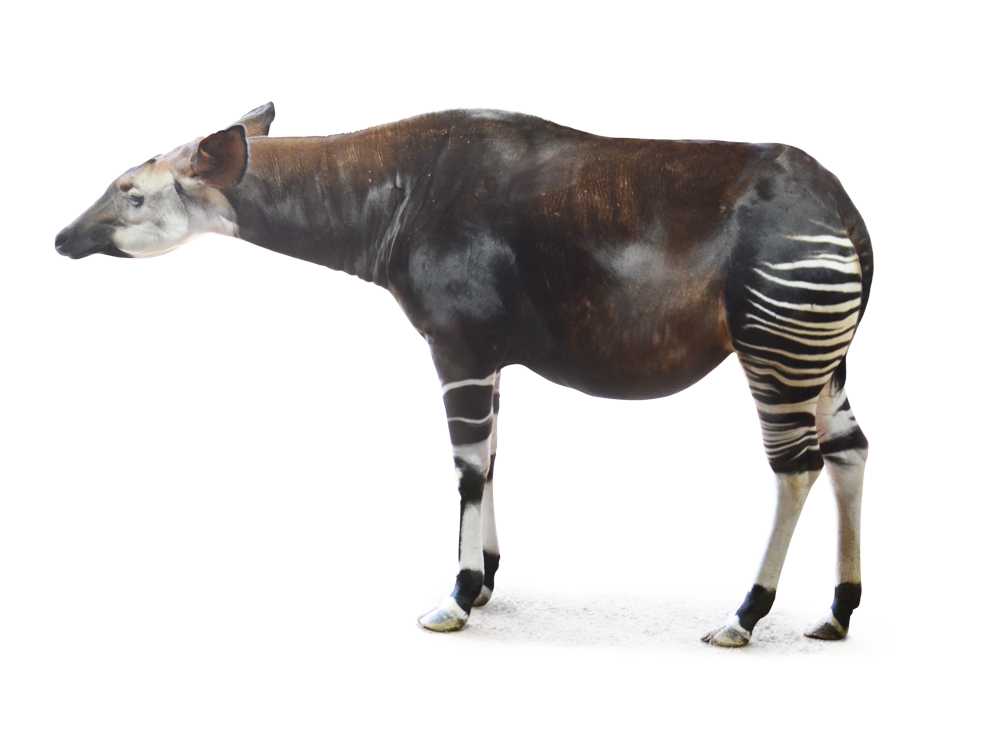
Okapia johnstoni (Sclater, 1901)
アフリカ最古の森に生きる神秘の動物
The Mysterious Animal of Africa’s Ancient Forest
オカピは中央アフリカの熱帯雨林に生息するキリン科の大型哺乳類です。頭胴長1.9〜2.5m、肩高1.5〜2.0m、体重は雄が約250kg、雌が約300kgになります。コンゴ民主共和国北東部を中心に分布し、標高500〜1,500mの密な熱帯雨林で単独性の生活を送っています。ベルベットのような質感を持つ赤褐色の体色と、脚に見られる白と暗色の縞模様が特徴です。この模様がシマウマに似ていることから、かつてはシマウマに近縁と考えられていましたが、その後の研究によりキリンの最も近い現生種であることが明らかになりました。
オカピはキリンと同様に黒く長い舌を持ち、その長さは約30cmに達します。この柔軟な舌を使って枝葉を巻き取るように採食し、森林環境に適応した食性を示しています。また舌は耳や瞼の清掃にも用いられます。キリンの額には「オシコーン」と呼ばれる皮膚に覆われた角がありますが、オカピでは雄にのみ2本見られます。オカピとキリンは約1,000万年前に共通祖先から分岐したと考えられており、キリンが開けた草原環境へ適応して首を伸ばしたのに対し、オカピは森林環境への適応を維持しました。
オカピが大きく形態を変えずに存続してきた背景には、コンゴ盆地の安定した森林環境があります。この地域の熱帯雨林は数百万年にわたり比較的変化が少なく、森林に適応した大型草食獣が生息し続ける条件を保ってきました。特にコンゴ民主共和国北東部に広がるイトゥリの森はアフリカでも古い森林の一つで、ゴリラやチンパンジー、コロブス類など12種の霊長類をはじめ、森林ゾウやボンゴ、さらに300種以上の鳥類が生息する生物多様性の高い地域です。この森に含まれるオカピ野生動物保護区には約5,000頭が生息し世界遺産に登録されていますが、密猟や焼畑農業、武装勢力の活動による生息地の悪化が続き、1997年から危機遺産にも指定されています。

The okapi is a large mammal of the giraffe family inhabiting the tropical rainforests of Central Africa. It measures 1.9–2.5 m in head-body length and stands 1.5–2.0 m at the shoulder. Males weigh around 250 kg, while females reach approximately 300 kg. The species is primarily distributed in the northeastern region of the Democratic Republic of the Congo, where it lives solitarily in dense rainforests at elevations between 500 and 1,500 m. Its velvety reddish-brown coat and distinctive white and dark stripes on the legs are characteristic features. Because of these markings, the okapi was once thought to be closely related to zebras, but later research revealed that it is the closest living relative of the giraffe.
Like giraffes, okapis possess a long, dark-colored tongue that can reach about 30 cm in length. This flexible tongue allows them to grasp and strip leaves from branches, reflecting their adaptation to forest feeding. The tongue is also used to clean the ears and eyelids. Giraffes have skin-covered horn-like structures called ossicones on their foreheads, and in okapis, two ossicones are present only in males. Okapis and giraffes are believed to have diverged from a common ancestor approximately 10 million years ago. While giraffes adapted to open savanna environments by evolving longer necks, okapis retained their specialization for forest habitats.
The persistence of the okapi’s body form is closely linked to the stable forest environment of the Congo Basin. The tropical rainforests of this region have remained relatively unchanged for millions of years, allowing forest-adapted large herbivores to continue inhabiting the area. The Ituri Forest in northeastern Democratic Republic of the Congo is considered one of Africa’s oldest forests. It supports remarkable biodiversity, including twelve species of primates such as gorillas, chimpanzees, and colobus monkeys, as well as forest elephants, bongos, and more than 300 bird species. The Okapi Wildlife Reserve, located within this forest, supports an estimated population of about 5,000 okapis and is designated as a World Heritage Site. However, poaching, slash-and-burn agriculture, and armed conflicts continue to degrade the habitat, and the reserve has been listed as a World Heritage Site in Danger since 1997.
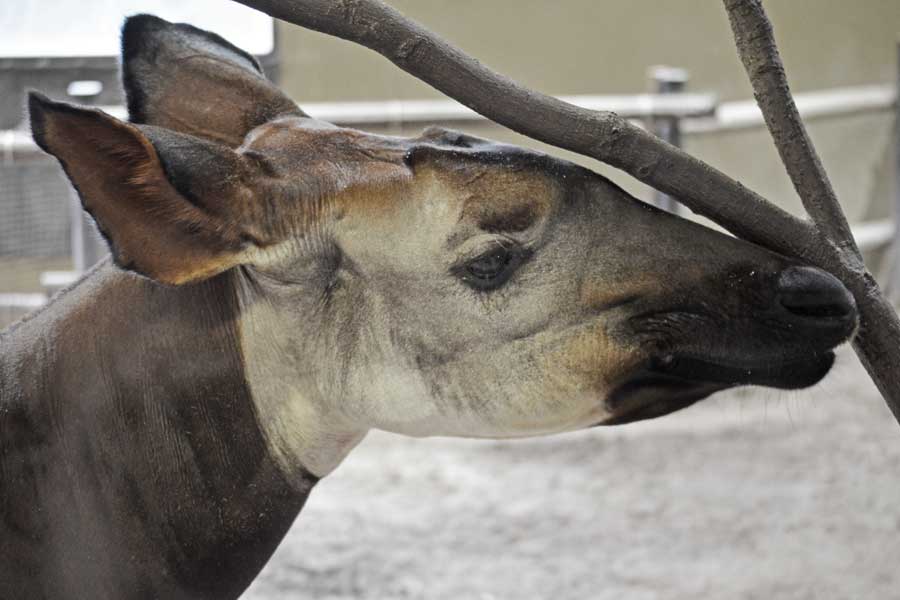
Sensitive ears that move independently to detect surrounding sounds and subtle movements

Base of the ossicones developed only in males and the elongated muzzle
参考文献
Ewango, Corneille (2025年7月27日)「オカピの森:歴史、課題、そして希望」第9回東京アフリカ開発会議(TICAD9)パートナーシップ事業イベント, よこはま動物園ズーラシア. 2026年2月22日閲覧
“Okapi” Denver Zoo Conservation. 2026年2月22日閲覧
ウォーカープラス | 世界三大珍獣・オカピは首の伸びなかったキリン!?神秘的な素顔や野生の真実を聞いてみた【会えなくなるかもしれない生き物図鑑】| (2022年12月8日) 2026年2月22日閲覧
“OKAPI (Okapia johsntoni)” EAZA Best Practice Guidelines. 2026年2月22日閲覧