
Tachybaptus ruficollis (Pallas, 1764)
神出鬼没な小さな水鳥
The Elusive Little Waterbird
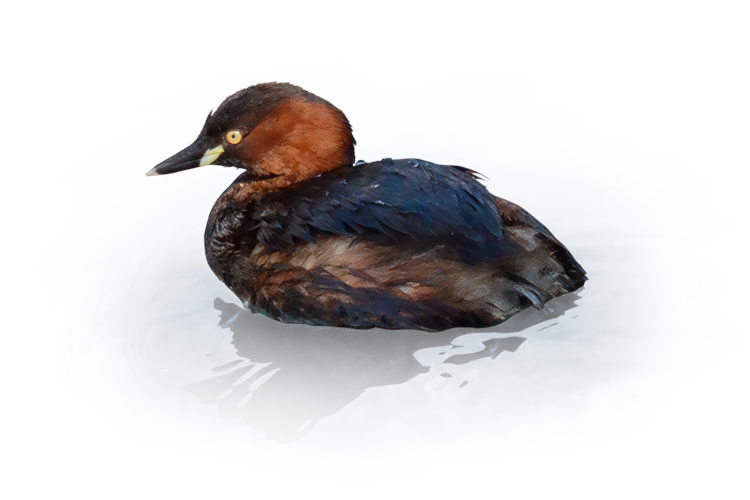
全長は約26cmです。アフリカ大陸からユーラシア大陸、オセアニアの温帯および熱帯域に広く分布し、日本では本州中部以南で留鳥として、東北北部から北海道では夏鳥として生息します。夏羽では全体的に暗色で、首は赤褐色を帯び、黒い嘴の基部にある黄白色の斑が特徴です。冬羽になると全身は淡褐色となり、嘴も黄色みを帯びるため、目立たない印象になります。
都市公園の池ではカモ類とともに観察されることが多く、その小さな体つきからカモの幼鳥と間違われることもあります。しかし、カモ類とは系統的に遠く、意外なことに遺伝子研究によってカイツブリはフラミンゴ類と近縁であることが示されています。さらに、2008年に発表された大規模な鳥類の遺伝子解析では、ハト類との近縁性も明らかになりました。外見からは想像しにくい関係ですが、これらの鳥が似ていないのは、生活環境の違いが形態を大きく変化させたためと考えられています。鳥類は卓越した移動能力、すなわち飛翔能力を備えることで、他の動物よりも早い段階から多様な環境へ進出し、適応放散を遂げてきました。
足の指に木の葉状の水かきを持つカイツブリは潜水を得意とし、その名は「掻き潜り」に由来するといわれています。水面にいたかと思えば瞬時に潜り、少し離れた場所から姿を現すことも多い、神出鬼没な水鳥です。水と深く関わる鳥であることから、和製漢字では「鳰」と書かれます。生息数の多い琵琶湖は古くから「鳰の海」とも呼ばれてきました。近江をこよなく愛した俳人・松尾芭蕉は、冬の琵琶湖の一瞬の情景を、次の一句に留めています。
「かくれけり 師走の海の かいつぶり」
水面に現れては消えるその姿は、静まり返った冬の湖とともに、人の記憶の中にも淡く刻まれてきました。
The Little Grebe is a small waterbird measuring approximately 26 cm in length. It is widely distributed across temperate and tropical regions of Africa, Eurasia, and Oceania. In Japan, it is a resident species from central Honshu southward, while in northern Tohoku and Hokkaido it occurs as a summer visitor. In breeding plumage, the overall coloration is dark, with a reddish-brown neck and a distinctive yellowish-white patch at the base of the black bill. In winter, the plumage becomes pale brown, and the bill turns yellowish, giving the bird a more inconspicuous appearance.
In urban park ponds, the Little Grebe is often observed alongside ducks and is sometimes mistaken for a duckling due to its small size. However, it is only distantly related to ducks. Surprisingly, genetic studies have shown that grebes are more closely related to flamingos. Furthermore, large-scale avian genetic analyses published in 2008 revealed a close evolutionary relationship with pigeons as well. Although these birds appear very different in form, such differences are thought to result from adaptations to contrasting environments that have led to marked changes in morphology. Birds, endowed with exceptional flight ability, were able to disperse into diverse habitats early in their evolutionary history, promoting rapid adaptive radiation.
The Little Grebe has lobed toes resembling small leaves, an adaptation that makes it an excellent diver. Its Japanese name is said to derive from the phrase meaning “to dive while paddling.” It often disappears beneath the water surface in an instant, only to reappear some distance away, giving it an almost elusive quality. Reflecting its aquatic lifestyle, it is written with the Japanese character “鳰.” Lake Biwa, where the species is particularly abundant, has long been known as “Nio-no-Umi,” the Sea of Grebes. The haiku poet Matsuo Bashō, who deeply loved the region of Ōmi, captured a fleeting winter scene of Lake Biwa in the following verse:
“Hidden away—
on the sea of the twelfth month,
the little grebe.”
Appearing briefly on the water’s surface before vanishing again, the Little Grebe has quietly left its impression not only on winter lakes but also in human memory.
参考文献
森と水の郷あきた | 野鳥シリーズ65 カイツブリ 2026年1月10日閲覧
AFP BB News | 鳥類進化解明に前進、大規模ゲノム解析で驚きの発見相次ぐ | (2014年12月12日) 2026年1月10日閲覧
むなかた電子博物館 | 野鳥 | カイツブリ 2026年1月10日閲覧
認定NPO法人 バードリサーチ | ニュースレター2005年6月号 (Vol.2 No.6)|(2006年6月16日) 2026年1月10日閲覧
公益社団法人俳人協会・俳句文学館 | 俳句の庭/第28回 かいつぶりの冒険 小澤 實 2026年1月10日閲覧