
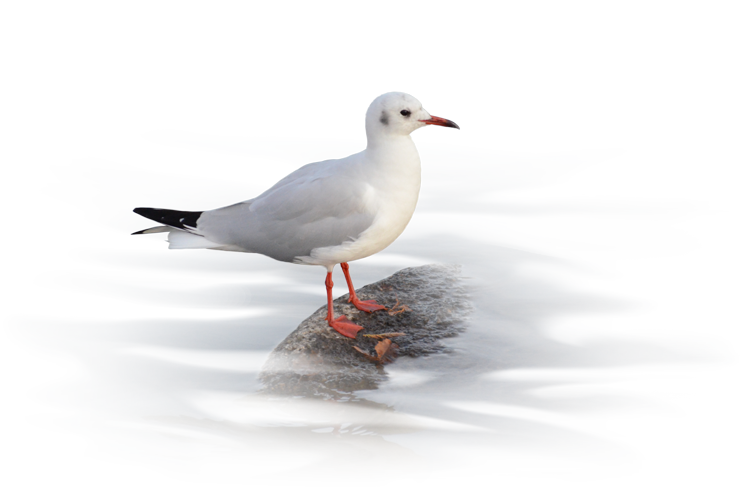
Chroicocephalus ridibundus (Linnaeus, 1766)
黒い頭部は配偶者選びの決め手
A Dark Hood as the Key to Mate Choice
全長約40 cm、翼開長約93 cm。ユーラシア大陸に広く分布する小型のカモメで、日本にはシベリアやカムチャツカ半島などで繁殖した個体群が10月頃から冬鳥として飛来します。他のカモメと違い、くちばしと脚が赤いのが特徴で、翼の上面は淡い灰色、初列風切の先端は黒く、さらに目の上部と後方に黒い斑があります。夏には換羽して頭部全体が暗色となり、これを「フード(hood)」と呼び、雄雌ともに生じます。フードが大きい個体は血中ヘモグロビン濃度が高く、すなわち体調が比較的良好である傾向が知られています。また、フードが大きいほどストレスが少ない傾向にあり、雄だけでなく雌も視覚的オーナメントとして利用している可能性があり、「相互配偶者選択(mutual mate choice)」が示唆されます。
日本の古典文学に登場する「都鳥」は、ユリカモメを指すという説が有力です。『伊勢物語』では「京には見えぬ鳥」と記されていますが、現在の京都では普通に観察できます。京都にユリカモメが初めて現れたのは1974年初頭で、約200羽が鴨川に飛来しました。1980年代には個体数が急増し、ピーク時には約8000羽が記録されましたが、近年は減少傾向が続き、2017年の調査では約420羽となっています。大きな要因として、繁殖地であるカムチャツカ半島の営巣数の変動が挙げられます。また、都市の安定した環境や人為的給餌により増加した個体数は、給餌の禁止、大規模な河川工事、越冬地の分散などを背景に次第に減少したと考えられます。「都鳥」の名は別種のミヤコドリ Haematopus ostralegus に譲りましたが、千年の時を経て都に姿を現したユリカモメの行方が注目されます。
Measuring about 40 cm in length with a wingspan of roughly 93 cm, the Black-headed Gull is a small gull widely distributed across the Eurasian continent. In Japan, individuals that breed in regions such as Siberia and the Kamchatka Peninsula arrive as winter visitors from around October. Unlike other gulls, it is distinguished by its red bill and legs, pale gray upperwings with black-tipped primaries, and black spots above and behind the eyes. In summer, it molts into a dark hood that covers the entire head, a feature seen in both males and females. Studies have shown that individuals with larger hoods tend to have higher blood hemoglobin levels, indicating comparatively good physical condition. Larger hoods are also associated with lower stress levels, and both sexes may use this trait as a visual ornament, suggesting the possibility of mutual mate choice.
In classical Japanese literature, the “Miyakodori” (Bird of the Capital) is widely believed to refer to this species. Although it is described in The Tales of Ise as a bird “not seen in the capital,” it can now be observed regularly in Kyoto. The species first appeared in the city in early 1974, when about 200 individuals arrived on the Kamo River. Numbers increased rapidly through the 1980s, peaking at nearly 8,000, but have since declined; a 2017 survey recorded only about 420. One major factor is fluctuation in the number of breeding pairs on the Kamchatka Peninsula. In addition, populations that once grew thanks to the stable urban environment and intentional feeding have declined following feeding bans, large-scale river construction, and the dispersal of wintering sites. Although the name “Miyakodori” is now reserved for the Eurasian Oystercatcher (Haematopus ostralegus), the movements of the Black-headed Gull—returning to the ancient capital after more than a millennium—continue to draw interest.
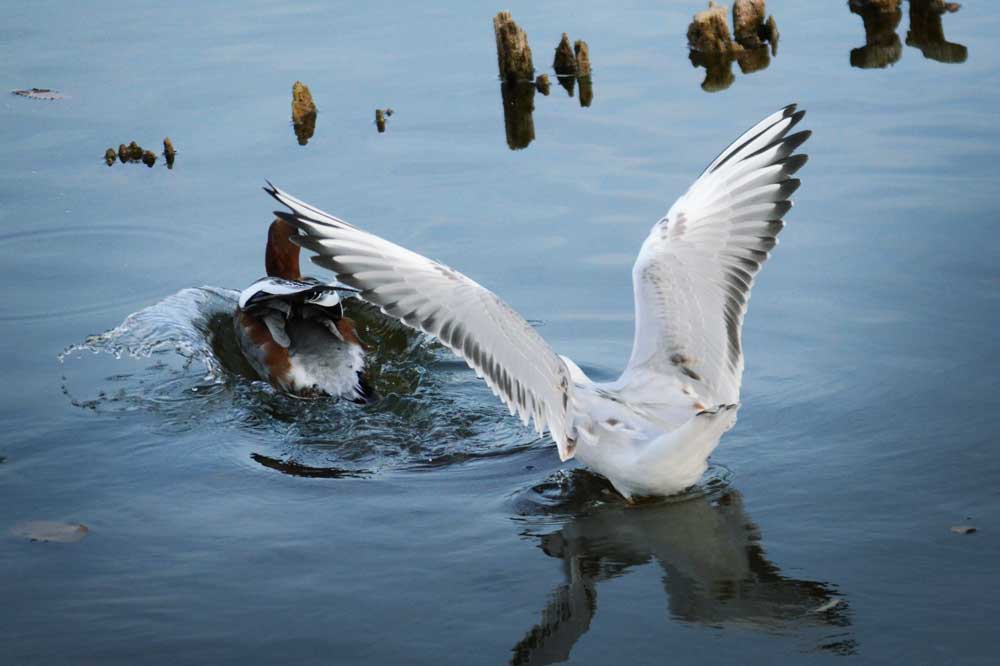
A black-headed gull chasing a wigeon
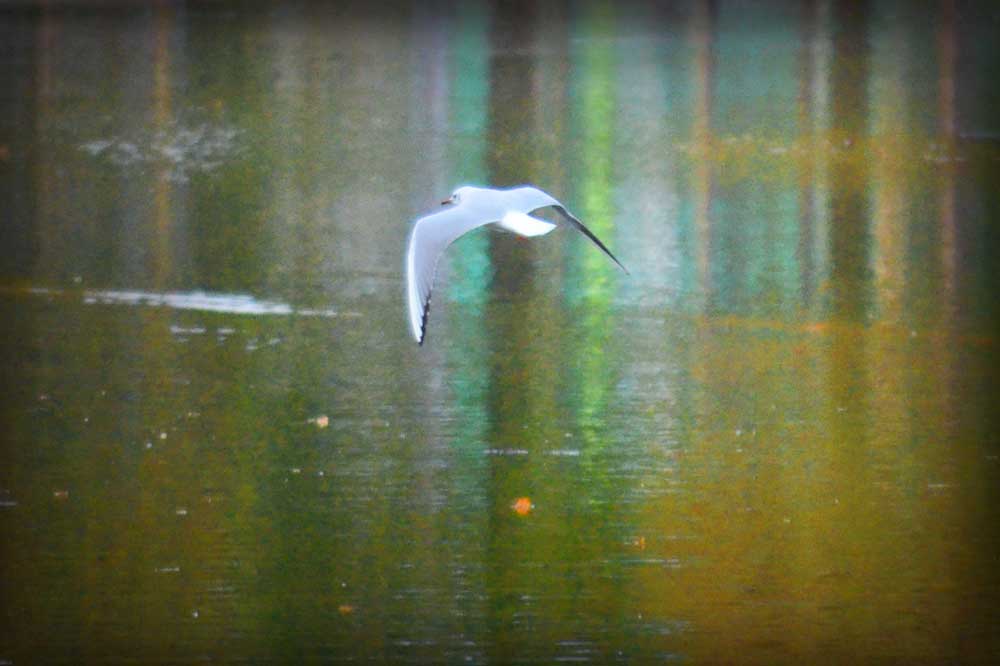
Flying lightly over the lake
参考文献
Bird Research News Vol.5 No.1 (2008年1月21日), 認定NPO法人バードリサーチ. 2025年12月6日閲覧
森と水の郷あきた | 野鳥シリーズ96 ユリカモメ 2025年12月6日閲覧
Minias, P., Indykiewicz, P., Nowakowski, J.J. et al. Melanin-based plumage ornamentation signals condition and physiological stress in the Black-headed Gull. J Ornithol 160, 1159–1169 (2019). 2025年12月6日閲覧
葦は、たのしく | “京には見えぬ鳥なれば” ~古典文学の中のユリカモメたち~ | 2025年5月3日 2025年12月6日閲覧
京都大学新聞 | 企画 | 京都の白い冬 ユリカモメを追うー北に過去に | (2016年1月16日) 2025年12月6日閲覧
日本野鳥の会京都支部 | 鴨川鳥類生態調査 2025年12月6日閲覧