
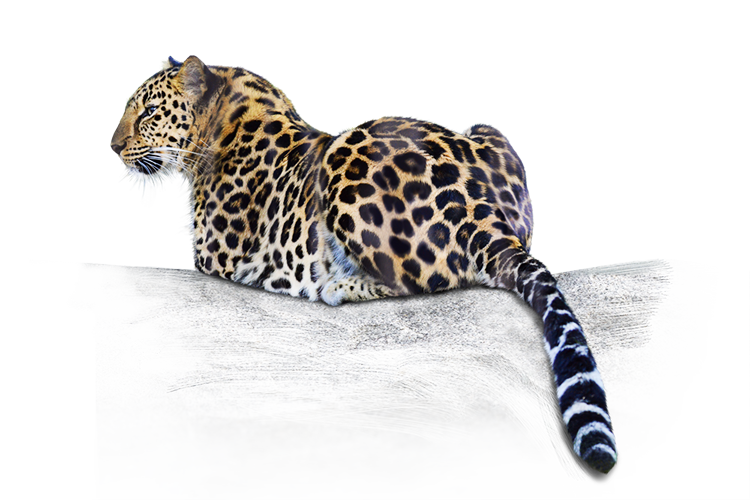
Panthera pardus orientalis (Schlegel, 1857)
極寒の森のサイレントキラー
The Silent Killer of the Frozen Forests
ヒョウ Panthera pardus は、ライオン、トラ、ジャガー、ヒョウ、ユキヒョウの5種からなる大型ネコ科のグループ、ヒョウ属(Panthera)の一種です。研究の結果、ヒョウはユキヒョウよりも、ライオンやジャガーと近縁であることが分かっています。ヒョウは生息地の違いによって9つの亜種に分類されており、そのうち最北端に分布するのがアムールヒョウです。ロシア南東部(沿海地方)から中国東北部にかけての国境地帯の森林に生息し、野生での個体数は100頭未満と推定されています。現在、極めて高い絶滅の危険性がある種として、絶滅危惧IA類(CR)に分類されています。
体長は1〜1.4m、体重は25〜50kgで、雄では最大75kgに達します。ヒョウの亜種の中でも比較的大型で、寒冷地に適応した密で厚い被毛を持つのが特徴です。夏毛は赤味がかった黄色、冬毛は明るいクリーム色となり、季節によって体色が変化します。尾は非常に長く、体に巻き付けて寒さを防ぐほか、走行時や跳躍時に体のバランスを保つ役割も果たします。狩りは主に夜明けや夕暮れに行い、**ウサギやネズミ類などの小動物だけでなく、シカやイノシシといった、自身の体重の3倍にもなる大型の獲物を仕留めることができる高い捕食能力を持っています。**物音を立てずに獲物に近づくのが得意なため、「サイレントキラー」とも呼ばれています。
寒冷な地域では獲物が少ないため、1個体あたりの行動範囲は非常に広くなります。しかし、生息地では道路や鉄道の建設、森林伐採、農地開発などによって環境の分断が進み、個体の移動が制限されています。さらに国境地帯にまたがって分布していることも、保全活動を難しくしています。一方、世界の動物園では野生個体数を上回る約200頭のアムールヒョウが飼育されており、計画的な繁殖管理を通じて、野生個体群を支える重要な役割を担っています。
The leopard (Panthera pardus) is one of the large cats belonging to the genus Panthera, which includes five species: the lion, tiger, jaguar, leopard, and snow leopard. Research has shown that the leopard is more closely related to the lion and jaguar than to the snow leopard. Leopards are divided into nine subspecies based on their geographic distribution, and the Amur leopard is the northernmost of them. It inhabits forested areas along the border between southeastern Russia (Primorsky Krai) and northeastern China, and the wild population is estimated to number fewer than 100 individuals. It is currently classified as Critically Endangered (CR) due to its extremely high risk of extinction.
The Amur leopard has a body length of 1.0–1.4 meters and weighs 25–50 kilograms, with males reaching up to 75 kilograms. It is relatively large among leopard subspecies and is characterized by dense, thick fur adapted to cold climates. The summer coat is yellowish with a reddish tone, while the winter coat becomes a pale cream color, changing with the seasons. Its long tail can be wrapped around the body to retain heat and also plays an important role in maintaining balance when running or leaping. Hunting mainly at dawn and dusk, it feeds not only on small animals such as rabbits and rodents but also on large prey such as deer and wild boar, sometimes weighing up to three times its own body weight. Because of its ability to approach prey silently, it is often referred to as a “silent killer.”
In cold regions where prey density is low, each individual requires a very large home range. However, habitat fragmentation caused by road and railway construction, logging, and agricultural development has restricted movement between areas. In addition, its distribution across an international border further complicates conservation efforts. Meanwhile, approximately 200 Amur leopards are kept in zoos worldwide, where they play an important role in supporting wild populations through carefully managed breeding programs.
参考文献
WWFジャパン | ヒョウとクロヒョウの違いとは? ~ネコ科動物が教えてくれる自然の世界【1】| (2025年11月14日) 2026年2月14日閲覧
WWFジャパン | よみがえれ、アジアのヒョウたち | (2014年5月14日) 2026年2月14日閲覧
“Top 10 Facts About Amur Leopards” WWF-UK. 2026年2月14日閲覧
“Amur Leopards” WWF-UK. 2026年2月14日閲覧
“Amur Leopard: Endangered Animals Spotlight” Earth. Org. 2026年2月14日閲覧
“Amur Leopard” World Association of Zoos and Aquariums. 2026年2月14日閲覧